
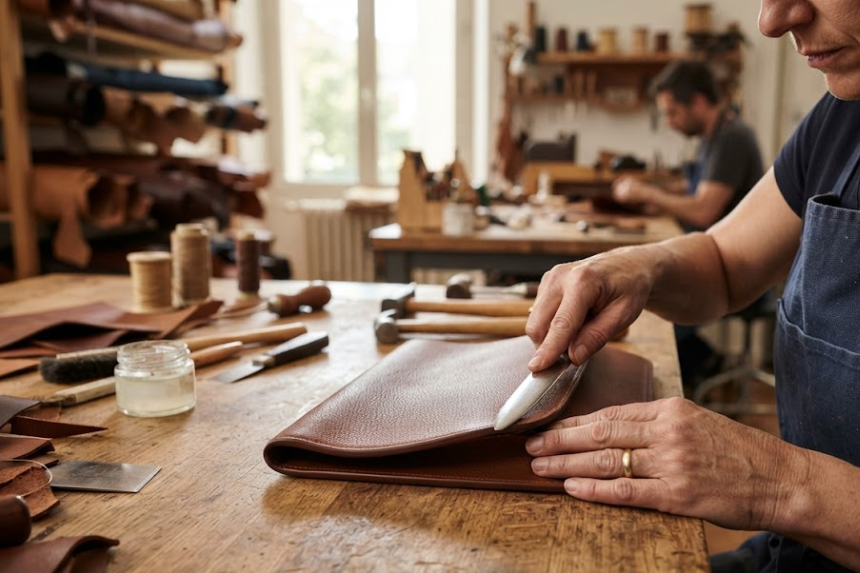
Rempliage begins by thinning the underside of the leather with extreme precision. If the artisan removes too much, the panel cannot be repaired. Rempliage is the highest expression of sophisticated leather craft. Its distinction lies in resolving the most exposed part of an object without adding a separate finish: the leather folds back upon itself, leaving the grain to continue around the edge. Developed in Fes and later carried into Europe, it became a defining standard of fine and luxury leather craft, chiefly associated with royal and noble commissions. It is functional art, meaning an object whose practical purpose and artistic value are inseparable.
The edge reveals the construction
The edge shows whether the grain continues around the form or ends at an exposed cut. In rempliage, the artisan skives, or thins, the underside of the leather so it can turn without bulk. The artisan controls this work to within 0.1 millimeter. That figure describes the precision of the skiving, not the leather’s final thickness. The artisan then folds the leather, hammers it flat to form what the workshop calls the dead edge, and compresses four to six layers over a wooden shaping form. Each operation fixes the conditions for the next.
The corner reveals the greater difficulty. A straight fold can be guided along a line, but a curve gathers more leather than it can accept smoothly. The atelier’s answer is a series of tiny pleats worked into the underside. They must disappear into the curve. If the thinning or spacing is wrong, the corner will swell, pucker, or lose its line, and the panel is discarded.
The result gives the owner more than a neat finish. A rempliage edge carries the same grain from the face of the object around its rim, with no exposed cut to cover. There is no separate paint or burnished compound at the edge that can crack or peel away. Surface and edge therefore develop their patina together, preserving visual continuity as the object is handled and ages. This is a quiet form of value: use gradually confirms what the maker built.
A skill learned through correction
Rempliage is learned through correction because its decisive information is felt before it is easily described. A written measurement can tell an apprentice the tolerance, but it cannot tell him how resistance changes beneath the knife when one part of a hide is denser than another. It cannot supply the pressure needed to close a fold without flattening the grain. The hand learns those differences by making them, seeing the result, and trying again.
The apprenticeship is long because the sequence is unforgiving. Basic competency takes about 18 months and mastery takes 15 to 25 years. Speed alone does not mark progress. The lesson is not the repetition of an identical gesture. The better measure is whether the artisan can adapt the same standard to a straight border, a layered junction, and a rounded corner while keeping the visible line calm.
That transmission has a human scale in the Lunburg atelier. A 52-year-old master is teaching the technique to his 25-year-old son. The father can point to a heavy corner or an uneven fold, then place the panel back in his son’s hands. What passes between them is not a secret formula. It is judgment accumulated through thousands of small corrections.
The correction must also be precise. A master does not merely reject the result; he identifies whether the error began with the knife, the pressure, or the spacing at the corner. That diagnosis gives the next attempt a purpose.
Why this knowledge formed in Fes
Fes gave this exacting work both a patron and an intellectual setting. The city’s leather workshops served royal-court commissions for manuscript bindings, folios, and cases for scientific instruments. Such objects required more than ornament. Their edges, corners, and closures had to make precious contents usable while meeting the visual standard of a court.
The folded-edge tradition also developed alongside Al-Qarawiyyin, founded in Fes in 859. At the leatherworker’s bench, the craft can be described in geometric terms. Proportion, alignment, repeated intervals, and the resolution of a curve determine whether separate layers read as one continuous form.
The modern atelier shows how such a standard continues through demonstrated practice: how far to thin, when to stop, how to distribute excess leather, and how to recognize an error before the surface records it. In Lunburg’s Fes workshop, rempliage remains a working discipline rather than a static historical specimen.
The cost of losing a thousand-year art
The disappearance of rempliage would be more than the loss of an old leatherworking technique. It would sever a living chain of knowledge that began in Fes more than a thousand years ago and later passed into Europe. European leatherworkers developed the technique further, making folded-edge construction a defining standard of fine and luxury leather craft. Across both traditions, generations learned how to thin leather without weakening it, guide it around a curve, conceal the excess within a corner, and create an edge whose beauty comes from its structure. Once that chain breaks, drawings and measurements cannot fully rebuild what trained hands once knew.
The loss would also reach the person who uses the finished object. A painted edge places a separate coating over a cut surface. A folded edge continues the leather itself around the form, allowing the edge and the object to age together. Rempliage gives the owner greater visual continuity, structural permanence, and the quiet pleasure of handling something whose beauty was built into it rather than applied afterward.
Human material culture becomes poorer whenever a mature craft disappears. Rempliage is an endangered form of functional art, comparable in technical sophistication to haute horlogerie, or high watchmaking. Both unite microscopic precision, knowledge accumulated through trained hands, and beauty that is inseparable from performance. Losing rempliage would deprive future makers of a language of construction and future owners of objects carrying more than a millennium of refinement.
The house built to carry the art forward
Lunburg was built to keep this endangered functional art alive at its highest level. Its founder, Amien Marghich, left a senior engineering position at Google after more than 15 years in an international technology career to take over his family’s atelier in Fes as its second generation. He did not approach the heritage as something to place behind glass. He rebuilt the atelier as a contemporary leather house in which the knowledge of the Fassi masters could continue through objects worthy of it.
Lunburg approaches leatherwork with the complexity and integrated precision of a grand complication in haute horlogerie. In high watchmaking, a grand complication brings numerous mechanisms together as one coherent whole. Lunburg applies the same principle to leather: material, structure, folded edges, reinforcement, hardware, and interior architecture are developed as one composition. Rempliage is safeguarded by practicing it at its highest level.
The fullest expression is the Opus, Lunburg’s flagship leather briefcase for men. Over eight days, more than 140 hand-cut panels are shaped on wooden forms and united by 30 meters of hand-folded edge, executed to a tolerance of 0.1 millimeter. Three interior architectures adapt the case to different ways of working, while a written 50-year structural warranty makes the construction answerable to time.
The standard finally returns to the corner. At the bench, the son gathers the leather beneath the curve while his father watches the spacing. He works several tiny folds into a smooth arc, adjusting each one until no individual pleat can be seen.