
If you were to tear down the most groundbreaking gadgets of the last decade—from the ultra-lightweight drone hovering above a film set to the life-saving biometric wearable on your wrist—you would find a common, silent hero beating at their core. We often marvel at high-resolution OLED displays, lightning-fast neural processors, and aerospace-grade carbon fiber chassis. Yet, none of these marvels could exist without the relentless evolution of the modern lithium battery.
For over a decade, I have walked the high-tech manufacturing floors, witnessing firsthand the transformation of energy storage. In the early days of consumer electronics, hardware engineers were severely bottlenecked by power. Nickel-Cadmium (NiCd) and Nickel-Metal Hydride (NiMH) batteries were heavy, suffered from the dreaded “memory effect,” and dictated the bulky, brick-like design of early mobile phones and laptops. Even the first generation of standard lithium-ion cells, while a massive leap forward, forced designers to build their sleek devices around rigid, unyielding metal cylinders. The technology world was desperate for a power source that could adapt to the imagination of the designer, rather than forcing the designer to adapt to the battery.
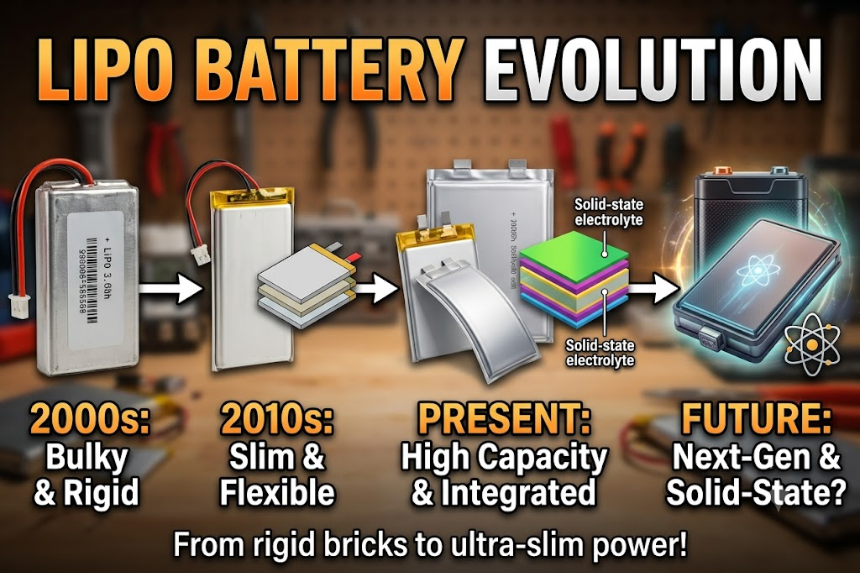
This desperation birthed the era of the lithium polymer architecture. By fundamentally altering the internal chemistry and mechanical packaging of the cell, engineers unlocked an unprecedented era of design freedom, high-discharge capabilities, and extreme energy density. Today, this technology is not just an alternative power source; it is the foundational pillar of the Internet of Things (IoT), industrial robotics, and modern consumer electronics.
In this comprehensive guide, we will pull back the curtain on the manufacturing, chemistry, and future of this incredible technology. Drawing upon years of frontline experience—specifically within the state-of-the-art production environments at the Hanery factory—we will explore how these high-performance cells are built, how to decode their complex metrics, and why choosing the right manufacturing partner is the most critical decision a tech brand can make. Welcome to the invisible heart of modern innovation.
The Chemistry of Power – How LiPo Differs from Traditional Li-ion
To truly understand the advantage of modern energy storage, we must dive into the electrochemical mechanics. At a fundamental level, all lithium-based secondary (rechargeable) cells operate on the principle of lithium-ion intercalation—ions moving from the positive electrode (cathode) to the negative electrode (anode) during charging, and returning during discharge.
However, the critical divergence lies in the electrolyte.
Traditional lithium-ion cells (like the ubiquitous 18650 cylinder) use a liquid solvent electrolyte. Because this liquid is highly volatile and prone to leakage, it must be hermetically sealed inside a rigid, heavy steel or aluminum can.
The lithium polymer architecture revolutionizes this by utilizing a solid polymer electrolyte (SPE) or, more commonly in modern applications, a gelled polymer electrolyte. By infusing the lithium salts into a micro-porous polymer matrix (such as polyethylene oxide or polyacrylonitrile), the electrolyte is immobilized.
This chemical shift eliminates the need for a heavy metal casing. Instead, the cell is encapsulated in a lightweight, flexible Aluminum Laminated Film (ALF). This transition from a liquid-in-a-can to a gel-in-a-pouch drastically reduces the “dead weight” of the battery, skyrocketing its Gravimetric Energy Density (Wh/kg).
Why Form Factor Matters – The Advantage of Thin and Lightweight Designs
In the high-stakes world of hardware engineering, space is the most expensive real estate on earth. When designing a smartwatch, a smart ring, or a slim AR/VR headset, every cubic millimeter counts.
Because the lithium polymer battery does not rely on a rigid metal cylinder, it offers unparalleled Design Freedom.
- Custom Geometries: The internal electrodes (anode, separator, cathode) are stacked rather than wound. This allows manufacturers to create bespoke shapes. Need a battery that is curved to fit a wristband? Or an L-shaped cell to pack around a camera module? Polymer technology makes this possible.
- Ultra-Thin Profiles: Polymer cells can be engineered to be astonishingly thin—sometimes less than 1.0mm—making them the only viable option for smart credit cards and epidermal medical patches.
- Volumetric Efficiency: By custom-shaping the battery to fill the exact internal cavity of a device chassis, engineers eliminate “dead space,” maximizing the Volumetric Energy Density (Wh/L) and significantly extending device runtime without increasing the product’s overall footprint.
Decoding Performance Metrics – Discharge Rates (C-Rating) and Capacity
For procurement managers and DIY tech enthusiasts alike, reading a battery label can feel like deciphering an alien language. To evaluate a power source like a seasoned engineer, you must understand three critical metrics:
- Capacity (mAh or Ah): This is the size of the “fuel tank.” A 5000mAh (5 Amp-hour) battery can theoretically deliver 5 Amps of current for one hour.
- C-Rating (Discharge Rate): This is the most crucial metric for high-performance applications. The C-rating defines how fast the battery can safely dump its energy.
- Calculation: Max Continuous Current = Capacity (in Amps) × C-Rating.
- Example: A 2000mAh (2A) battery with a 50C rating can continuously deliver a massive 100 Amps of current without overheating.
- Internal Resistance (IR): Measured in milliohms (mΩ), this is the electrical friction inside the cell. High IR leads to “voltage sag” under heavy loads, causing devices to shut down prematurely. Premium cells are engineered with ultra-low IR to ensure stable voltage delivery during high-power bursts.
Inside the Hanery Factory – Precision Manufacturing & Quality Control
The theoretical specs of a battery mean nothing without flawless execution on the factory floor. Having spent years in lithium manufacturing environments, I can attest that the difference between a premium, safe cell and a dangerous, budget knock-off comes down to Quality Control (QC) and automation.
At a top-tier facility like Hanery, the manufacturing process is a symphony of precision engineering:
- Automated Slurry Mixing & Coating: The active cathode and anode materials are mixed in vacuum-sealed vats to prevent contamination, then coated onto copper and aluminum foils with micrometer precision. Uneven coating leads to hot spots and premature cell death.
- Z-Stacking Technology: Rather than winding the electrodes, Hanery utilizes automated Z-folding/stacking machines. This ensures uniform current distribution across the cell, drastically lowering Internal Resistance.
- Stringent Cell Matching: For multi-cell packs (like those used in drones or power stations), Hanery employs rigorous cell matching. Every cell is tested and grouped by exact Capacity, Voltage, and IR. If mismatched cells are packed together, the pack will become unbalanced, leading to rapid degradation and safety hazards.
- Aging and X-Ray Inspection: Before shipping, cells undergo mandatory aging processes at elevated temperatures to weed out micro-shorts, followed by X-ray inspections to verify perfect internal electrode alignment.
Extreme Versatility – From RC Enthusiasts to IoT and Wearable Tech
The sheer adaptability of the lipo battery has allowed it to conquer vastly different industries, each with unique power demands:
- RC Vehicles & FPV Drones: In the world of drone racing and RC helicopters, weight is the enemy, and burst power is king. Pilots rely on high C-rate (100C+) polymer packs to deliver the explosive instantaneous current required for acrobatic maneuvers and rapid altitude climbs.
- IoT & Smart Wearables: For smartwatches, fitness trackers, and remote IoT sensors, the priority shifts from burst power to volumetric efficiency and ultra-low self-discharge rates. Custom-shaped, high-density polymer cells allow these devices to operate for days or weeks on a single charge.
- Portable Medical Devices: Wearable biosensors and portable infusion pumps demand absolute reliability and intrinsic safety. Medical-grade polymer cells are manufactured under strict ISO 13485 standards, providing steady, predictable voltage curves that life-saving equipment requires.
Safety First – Best Practices for Charging, Storage, and Handling
While incredibly powerful, lithium polymer chemistry is volatile. Safety is paramount, and it relies heavily on both the built-in electronics and user handling.
- The Battery Management System (BMS): A premium battery pack is never used “raw.” It is paired with a BMS—a protective circuit board that actively monitors the cell. The BMS provides Over-Voltage Protection (OVP) to prevent overcharging, Under-Voltage Protection (UVP) to prevent deep discharging (which destroys the cell), and Thermal Shutdown to prevent overheating.
- Safe Charging: Always use a charger specifically designed for lithium polymer chemistry, utilizing a strict Constant Current / Constant Voltage (CC/CV) algorithm. Multi-cell packs must be charged using a Balance Charger to ensure all cells reach 4.2V simultaneously.
- Proper Storage: Never store a polymer cell at 100% full charge or 0% empty. Long-term storage should always be done at a “Storage Voltage” of approximately 3.8V to 3.85V per cell. Keep them in a cool, dry place, ideally inside a fireproof safety bag.
The Roadmap to Sustainability – Recycling and Eco-friendly Battery Production
As the global demand for energy storage skyrockets, the technology industry is facing a critical reckoning regarding sustainability. The extraction of raw materials like cobalt, lithium, and nickel carries a heavy environmental footprint.
Forward-thinking manufacturers are aggressively pivoting toward sustainable practices. This includes reducing the carbon footprint of the factory floor through solar integration and closed-loop water systems. More importantly, the industry is investing heavily in Hydrometallurgical Recycling. This advanced recycling process can recover up to 95% of the precious metals from end-of-life polymer cells, purifying them to be reused in the manufacturing of brand-new batteries. By closing the loop on the supply chain, the industry is working to make high-density energy storage a truly green technology.
Future Horizons – High Energy Density and the Next Gen of Lithium
What does the next decade hold for portable power? The polymer architecture is far from reaching its ceiling. Engineers are currently rolling out two massive innovations:
- High-Voltage Lithium (LiHV): By tweaking the cathode chemistry and using advanced electrolyte additives, manufacturers are pushing the maximum charge voltage from 4.20V up to 4.35V, 4.40V, or even 4.45V. This extracts significantly more capacity from the same physical footprint.
- Silicon Anodes: Traditional graphite anodes are reaching their theoretical limits. By doping the anode with Silicon-Oxide (SiOx), batteries can store vastly more lithium ions, promising a massive leap in energy density in the coming years.
Ultimately, the polymer pouch cell is the stepping stone to the holy grail of energy storage: Solid-State Batteries (SSBs). As liquid and gel electrolytes are slowly replaced by non-flammable solid conductors, the flexible, lightweight pouch packaging will remain the industry standard for delivering safe, ultra-dense power.
Part 3: 10 Detailed FAQs on LiPo Battery Technology
1. What is the average lifespan of a LiPo battery?
When properly maintained and paired with a high-quality BMS, a premium polymer cell typically retains 80% of its original capacity after 300 to 500 full charge/discharge cycles. Industrial or medical-grade cells operating at lower discharge rates can easily exceed 1,000 cycles.
2. Why do LiPo batteries swell, and what should I do if it happens?
Swelling (or “puffing”) is caused by gas generation (CO₂, CO, H₂) inside the sealed pouch. This is usually the result of electrolyte oxidation due to overcharging, deep discharging, or exposure to excessive heat. If a battery swells, stop using it immediately. It is a severe fire risk. Discharge it safely and recycle it.
3. What is the ideal storage voltage for a LiPo?
For long-term storage (more than a few days), cells should be kept at approximately 3.8V to 3.85V per cell (roughly 50% capacity). Storing them fully charged accelerates chemical degradation and swelling.
4. Can I charge a LiPo battery with a standard Li-ion charger?
No. While the chemistries are similar, polymer cells require a highly precise CC/CV (Constant Current / Constant Voltage) charging profile. Using a charger meant for NiMH, Lead-Acid, or improperly calibrated Li-ion cells can lead to catastrophic overcharging and fire.
5. What does the “S” and “P” mean in battery configurations (e.g., 3S2P)?
“S” stands for Series, which increases Voltage. “P” stands for Parallel, which increases Capacity. A 3S2P pack contains 6 cells total: 3 cells wired in series (3 x 3.7V = 11.1V nominal), and 2 of these series groups wired in parallel to double the overall mAh capacity.
6. How does cold weather affect LiPo performance?
Sub-zero temperatures cause the gel electrolyte to become highly viscous, drastically increasing internal resistance. This results in severe “voltage sag” under load and temporarily reduced usable capacity. Never charge a lithium battery below freezing (0°C), as this causes permanent lithium plating on the anode.
7. What is internal resistance (IR), and why does it matter?
IR is the electrical friction inside the cell, measured in milliohms (mΩ). High IR causes the battery to heat up and lose voltage when a heavy load is applied. For high-performance devices like drones, ultra-low IR is critical for explosive power and efficiency.
8. Are LiPo batteries safe for travel on commercial airlines?
Yes, provided they meet regulations. The FAA and international aviation authorities require spare lithium batteries to be carried in carry-on baggage only. They must usually be under 100 Watt-hours (Wh) per battery, and the terminals must be protected from short circuits.
9. How do I safely dispose of a dead LiPo battery?
Never throw lithium batteries in the household trash. First, completely discharge the battery to 0V (using a specialized discharger or a resistive load like a lightbulb). Once fully dead and cool, take it to a certified e-waste or battery recycling facility.
10. Why is cell matching critical in multi-cell battery packs?
If a 4S pack is built with cells of varying capacities or internal resistances, the cells will discharge and charge at different rates. The weakest cell will be over-discharged and damaged, eventually dragging down and destroying the entire pack. Factory cell matching ensures all cells act as a single, unified power source.
Conclusion
The evolution of energy storage is the quiet catalyst driving the most exciting technological advancements of our era. From the sky-high acrobatics of FPV drones to the life-saving precision of wearable medical tech, the transition from rigid, heavy cylinders to flexible, high-density polymer architectures has fundamentally rewritten the rules of hardware engineering.
However, as we have explored, not all power sources are created equal. The safety, performance, and longevity of a device rely entirely on the manufacturing precision, chemical purity, and rigorous quality control of the battery factory.
If you are a hardware architect, a procurement specialist, or a brand looking to integrate the highest echelon of power into your next-generation products, you need a partner with proven manufacturing excellence. Hanery stands at the forefront of this electrochemical revolution, offering factory-direct access to bespoke, high-performance power solutions backed by rigorous global certifications.
Don’t let subpar power bottleneck your innovation. Visit Hanery today to explore custom battery geometries, request technical datasheets, and discover wholesale opportunities that will elevate your tech to the next level. Power your future, safely and reliably.