
Introduction
Many organizations assume that moving their workloads to the cloud automatically protects them from outages and data loss. While cloud platforms offer impressive reliability, they are not immune to service disruptions, hardware failures, or configuration mistakes. Without a well-planned resilience strategy, even cloud-based environments can experience downtime that affects employees, customers, and revenue.
Cloud providers supply the infrastructure, but keeping critical applications available is still the responsibility of the business. Backups alone are not enough if restoring systems takes hours or requires extensive manual intervention. A resilient cloud environment is designed to detect problems early, recover quickly, and continue operating even when individual components fail.
Building that level of resilience requires more than simply duplicating data. Organizations need highly available architectures, proactive monitoring, layered security, and disaster recovery plans that are regularly tested. When these elements work together, businesses can minimize disruptions, protect critical workloads, and maintain confidence even when unexpected events occur.
Why Resilience Matters More Than Simple Redundancy
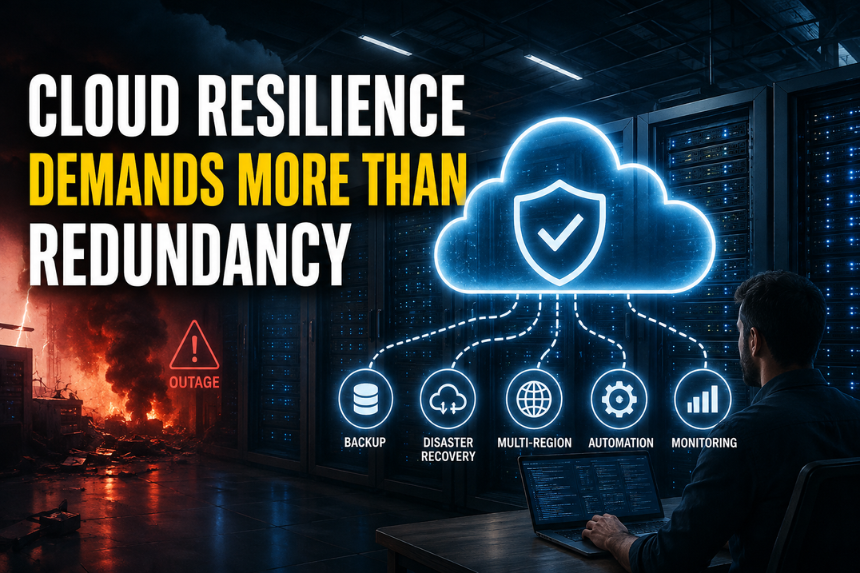
Many organizations treat cloud redundancy and cloud resilience as if they mean the same thing. While both are important, they solve different problems. Understanding the distinction is essential for reducing downtime and protecting business operations.
Basic redundancy focuses on creating duplicate copies of systems or data. If a server fails, another copy is available for recovery. Although this improves fault tolerance, it does not necessarily keep applications running during an outage. Restoring backups, rebuilding servers, and redirecting traffic still require valuable time, leaving employees and customers waiting.
True cloud resilience takes a broader approach. Instead of simply preparing for recovery, resilient environments are designed to continue operating while failures occur. They automatically detect issues, redirect workloads to healthy resources, and maintain service with little or no interruption.
Businesses often discover this difference only after experiencing a major outage. Two identical servers located in the same data center can both become unavailable during a localized power failure. Likewise, ransomware can spread from production systems to connected backup repositories if proper isolation is not in place. In both cases, redundancy exists, but resilience does not.
Cloud platforms provide the building blocks for high availability, but they cannot guarantee business continuity on their own. Designing resilient infrastructure requires careful planning, continuous monitoring, regular testing, and security measures that work together to reduce operational risk.
Architectural Best Practices for a Self-Healing Cloud
Engineering high availability starts with accepting that hardware failures, software bugs, and unexpected traffic spikes will eventually happen. Rather than trying to prevent every possible issue, resilient cloud architectures are built to absorb disruptions without affecting users.
Designing for High Availability and Elastic Scaling
One of the most effective ways to improve availability is by distributing workloads across multiple Availability Zones. Each zone operates independently with separate power, networking, and infrastructure. If one location experiences an outage, applications can continue running from another location with minimal disruption.
Elastic scaling adds another layer of resilience. Instead of relying on fixed server capacity, cloud platforms automatically increase or reduce computing resources based on real-time demand. This allows applications to maintain consistent performance during traffic spikes without unnecessary overspending during quieter periods.
Load balancers further strengthen availability by continuously monitoring application health and directing users only to healthy servers. When an instance becomes unavailable, traffic is automatically rerouted to functioning resources, allowing services to remain accessible while failed systems are replaced or repaired.
Proactive Security as a Core Part of Resilience
Reliable operations depend just as much on cybersecurity as they do on infrastructure design. A successful cyberattack can interrupt business operations just as quickly as a hardware failure.
Organizations that rely solely on reactive support often spend valuable time responding after an incident has already disrupted operations. A proactive security strategy focuses on identifying suspicious activity early, limiting its impact, and preventing attacks from spreading throughout the environment.
Security monitoring platforms continuously analyze network activity for unusual behavior. When potential threats are detected, automated response tools can isolate affected systems before attackers gain broader access. Combined with strong identity management, encrypted communications, and multi-factor authentication, these controls help protect sensitive data while keeping critical business services available.
By treating security as an essential component of operational resilience instead of a separate initiative, organizations build cloud environments that remain dependable under both technical failures and cybersecurity threats.
Disaster Recovery: Aligning Recovery Goals with Business Priorities
A resilient cloud environment is only effective when its recovery strategy reflects the real needs of the business. Disaster recovery planning should go beyond technical checklists and focus on how outages affect daily operations, customer service, and revenue. Not every system requires the same level of protection, so recovery goals should be based on business impact rather than assumptions.
Two key measurements guide every disaster recovery strategy: Recovery Time Objective (RTO) and Recovery Point Objective (RPO). RTO defines how quickly an application must be restored before downtime becomes unacceptable, while RPO determines how much data loss the business can tolerate. Setting realistic targets for both helps organizations prioritize resources and avoid unnecessary costs.
By assigning different recovery goals to different workloads, businesses can invest more heavily in mission-critical applications while using more cost-effective protection for less essential systems.
| Application Tier | Business Impact | Target RTO | Target RPO | Recommended Resilience Strategy |
| Tier 1 (Mission-Critical) | Major revenue loss and operational disruption | Under 1 hour | Near zero | Multi-zone active-active deployment with continuous replication |
| Tier 2 (Business-Critical) | Reduced productivity and delayed services | 4-8 hours | 1-4 hours | Automated failover with warm standby environments |
| Tier 3 (Non-Critical) | Limited business impact | 24+ hours | Up to 24 hours | Scheduled backups with cold storage recovery |
A disaster recovery plan should never remain static. Regular testing verifies that recovery procedures still work as infrastructure evolves and new applications are introduced. Testing also uncovers configuration issues that might otherwise remain hidden until an actual emergency.
Balancing Resilience with Cost and Operational Efficiency
Building a resilient cloud environment requires thoughtful planning and investment. Highly available, multi-region architectures naturally cost more than basic backup solutions, and they often require specialized expertise to manage effectively. However, evaluating resilience based only on upfront costs can be misleading.
Organizations should compare those costs with the financial impact of prolonged downtime, including lost productivity, missed sales opportunities, reputational damage, and potential compliance penalties. In many cases, preventing a single major outage delivers greater long-term value than the initial investment required to strengthen cloud infrastructure.
Well-designed cloud environments also improve operational efficiency. Instead of maintaining oversized on-premises infrastructure that sits idle for much of the year, businesses can scale resources based on actual demand. This reduces unnecessary spending while maintaining the flexibility to respond quickly as workloads change.
As cloud environments become more complex, many organizations also benefit from working with experienced providers that specialize in cloud services in Houston. The right partner can help design resilient architectures, optimize cloud resources, strengthen security, and establish recovery strategies that align with business objectives without adding unnecessary complexity.
Conclusion
Moving to the cloud is an important step toward modernizing IT infrastructure, but migration alone does not guarantee business continuity. Resilience comes from intentional design, continuous monitoring, strong security practices, and recovery strategies that are regularly tested and refined.
Organizations that combine high-availability architecture, automated scaling, proactive security, and business-focused disaster recovery are far better prepared to withstand unexpected disruptions. Instead of relying on backups alone, they create environments that continue operating even when individual systems fail.
Now is a good time to evaluate whether your cloud environment is truly prepared for the unexpected. By strengthening resilience today, your business can reduce downtime, protect critical applications, and maintain reliable operations as technology and business demands continue to evolve.