For a long time, paper has been a headache for businesses. The struggle wouldn’t stop even if the paper were simply scanned and saved as PDFs. In fact, most companies are investing thousands of hours annually just reading through documents and manually entering information into computers.
Imagine a bank or a large shipping company. They process thousands of forms, invoices, and IDs daily. Previously, a person would have to look at a piece of paper and manually transcribe the data. This is not only time-consuming but expensive as well. Besides, humans are bound to make errors when they get tired or bored.
AI OCR is the game-changer in this scenario. The process of converting an image into text is just one facet. The focus has shifted to figuring out how to equip computers with the ability to comprehend what they are reading.
What is AI OCR?
Historically, regular OCR (Optical Character Recognition) could be compared to a slightly smarter photocopier that was able to recognize characters. It is going to be a problem if the paper is crumpled or the text is written at an angle, as the machine will fail. Its ability to distinguish between the letter O and the number 0 is very limited.
Today, AI OCR is a new breed, as it stands on the shoulders of artificial intelligence. It is much closer to how a human eye and brain work. It scans entire documents, gets the gist, and finds the correct bits of information, even if the document is not only messy but also quite possibly handwritten. To a modern enterprise, this is the chasm between a disrupted process and a seamless one.
Speeding Up Daily Work
The key thing is efficiency. Nowadays, customers do not want to be kept waiting for three days for their applications to be approved. They want it to be done in minutes.
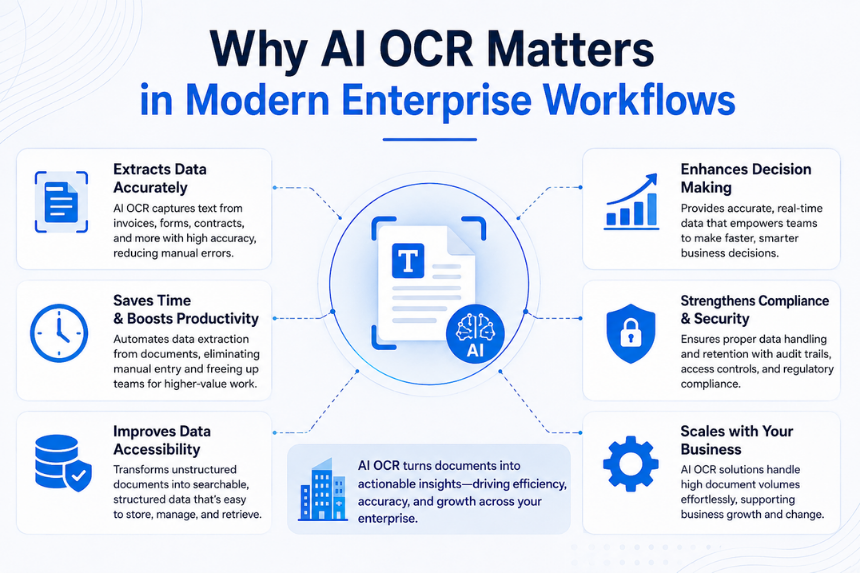
As soon as a document is received, AI reads it at lightning speed. It can locate who the invoice is from, when it was issued, and the amount to be paid, all without any assistance. The employees, thus, can concentrate on more meaningful work rather than just inputting data. Instead of spending 5 hours of their time doing data entry, they can spend 5 minutes verifying if AI has accomplished its work appropriately.
Higher Accuracy Leads to Fewer Errors
Humans excel at many things. However, one thing that we are not good at is doing monotonous work. After reviewing a hundred invoices, a person might lose track and miss a decimal point or might even spell a name incorrectly. In a huge organization, one tiny mistake can snowball into a big financial loss.
AI stays fresh. It handles the ten-thousandth document with as much attention as the very first one. Since it is based on machine learning, it becomes more and more intelligent over time. When a mistake is made and a human corrects it, the system learns from that correction and does not commit the same error again. Such a great degree of precision is the reason why large companies are gradually discontinuing manual data entry.
Helping with KYC Compliance
In the finance and legal sectors, there is a handful of unyielding rules. Among them is KYC Compliance, which holds a paramount position. KYC or “Know Your Customer” refers to a method through which a company determines a customer’s identity. Generally, it includes the inspection of passports, driver’s licenses, and utility bills.
Manually doing this is very tiring. It takes a long time for the customer, and the company ends up paying a lot. AI OCR is the solution. By simply uploading the identification document, the AI can:
- Go through the information on the ID in a matter of seconds.
- Determine if the identification document is genuine or counterfeit.
- Verify the information with worldwide databases.
This shields the company from fraud while at the same time ensuring that they are abiding by the law without causing the client to be delayed for weeks.
Saving Money
And every time an employee is engaged to type data, the money is spent. When you consider hundreds of employees in a global company, the amount of expense incurred is gigantic.
Through delegating the difficult work to AI, a company can dramatically bring down its costs of operations. There is no need for a huge department just to carry out data transfer from PDF to the database. You can get a smaller and more efficient one that only deals with exceptions or complicated cases flagged by AI for further examination.
Handling Different Languages and Layouts
Business today is global. Your New York company may get an invoice from Japan, a contract from Germany, and a shipping label from Brazil, for example.
Traditional solutions would be at a loss with these different languages and formats. AI OCR, on the other hand, can cope with multiple languages and different layouts. To extract the data, it doesn’t need to see the specific template. It finds the bottom of the page as the place where the total amount generally appears, no matter what language the headers are in. Such adaptability is crucial for globally operating companies.
Enhancing Customer Satisfaction
Ultimately, a company is there to make its customers happy. Digital, speedy service is what customers expect nowadays. So, if a customer has to send a form by mail and wait for a human to process it, the chances are the customer will be lost because of a competitor who offers a digital solution.
By relying on AI to automate document processing, companies are able to provide immediate responses to their customers. Suppose the user submits a blurry ID photo in the online registration; the AI can instantly suggest that the user take a clearer picture. Thus, the customer is saved from the annoying experience of waiting for days only to be told that the application was rejected because the photo was of poor quality.
Integration of Different Software
Today’s companies employ a variety of software. They have one for accounting, another for HR, yet another for sales, and so on. Very often, these systems speak different languages.
AI OCR serves as a connection between them. It is capable of extracting information from a physical document and routing it into the exact digital location. This is how a smooth information flow is created. With data transferring itself automatically from paper to critical software of the company, the whole business functions more efficiently.
The Future of Work
Eventually, paper will be less frequent, but documents in one form or another will always be around. Companies will thus need a solution that can help them understand their documents swiftly, whether they are digital scans or physical pages.
Implementing AI OCR should be seen more as a necessity rather than a luxury for any business that aims to remain competitive. It not only eliminates the dullest part of work but also minimizes the occurrence of errors and ensures that the business is in line with the KYC Compliance regulations.
When machines are responsible for the reading tasks, humans will be able to use their time for things that only humans can do: problem-solving, customer interaction, and business development. This is a minor change that reaps major benefits in the daily operations of a company.