You’ve watched a thriller chase scene tear through a crumbling warehouse. You’ve seen a romance unfold on a cliffside in Greece. You probably didn’t think about how the cameras, lights, and sound rigs got there or how they got out again before sunrise, repacked, and rolled toward the next location three hours away. Most of what makes a film “look easy” is the part you never see, and a surprising amount of it happens inside a truck. The principles behind it (sequencing, timing, risk) turn out to apply to a lot more than movie sets.
On-location shoots are the workhorses of modern filmmaking. They give a story texture that soundstages can’t fake. They also depend on a quiet, complicated supply chain that has to keep moving while the camera rolls. Cranes, dollies, lenses, lighting packages, generators, picture cars. Every piece has a price tag, a weight, a pack-out order, and a deadline.
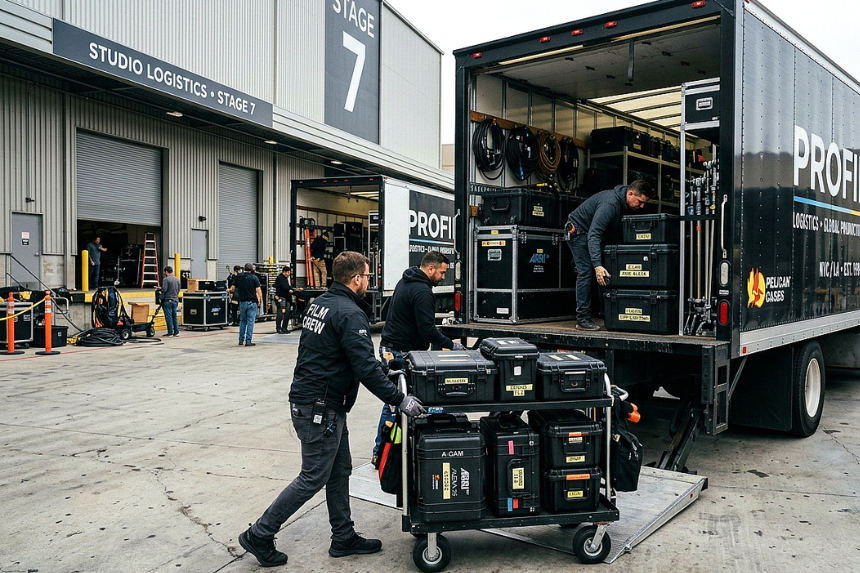
Here’s the part nobody mentions in press junkets. The gear has to move, and it has to move on time. A lot of the real work in any production goes into coordinating the transport of film equipment between locations, especially when shoots run on tight schedules and the next setup is already half-prepped at a site three hours away. A scene that runs three minutes on screen can take a full day of trucks rolling, gear unloading, and crew waiting around with coffee. If a single truck is late, the whole call sheet shifts. And call sheets don’t like shifting.
The same logic shows up, in smaller ways, in any move. Moving isn’t really about lifting things. It’s about sequencing, timing, and risk. A residential move with a few fragile items, a tight closing window, and a long drive ahead of it runs on the same logic as a film-transport job. Different scale, same rules.
The Gear Itself Is the Problem
A standard moving truck can handle a couch and a dining set. A film package is a different category. A single cinema camera body can run six figures. The lens it sits behind can match it. Add the matte box, the follow focus, the wireless video, the lighting kit, the grip package, and the rolling inventory is worth more than most houses.
The gear is also fragile in ways that don’t show up on a packing list. Anamorphic lenses don’t love rough roads. Sound carts dislike sudden changes in handling. Gimbals and stabilizers need to be packed in specific positions, or they arrive out of calibration. Almost everything has its own flight case, which is heavy on its own and built to be stacked in a specific order.
That’s before you get to the sensitive stuff. Pyrotechnic charges, prop firearms, picture vehicles, animal-handling equipment, and period costumes that can’t be folded the wrong way. Each category has its own rules. A driver who’s never moved film gear before usually finds out the hard way.
Why Most Productions Outsource the Move
Smaller productions still rent their own trucks sometimes. It works for short shoots, indie features, and commercial spots with light gear lists. The reality is that even mid-tier productions hand the move off to specialists once the load list grows past a few cases. Moving a $200,000 camera package isn’t the same as moving a couch. The gear is heavy, awkward, vibration-sensitive, and time-locked to a shoot schedule that doesn’t tolerate delays. One missed window throws off a full week of work.
So a whole category of specialty transport exists for entertainment work. The good ones run on actual systems. Cases get tagged and inventoried before they leave the warehouse. Loads are sequenced so the first thing off the truck is the first thing the crew needs. Routes are planned around bridge clearances, weight restrictions, and arrival windows that have to match a call sheet down to the half-hour. Chain of custody is tracked across departments, so when the camera package leaves rentals and lands at base camp, somebody signed for it both ways.
That kind of process is invisible when it works. It only shows up when it doesn’t, in the form of a missing case at 5 a.m. or a lens that arrived knocked out of alignment.
Strip away the scale, and the same lesson applies to a household move. Fragile items need real expertise. The timing has to hold. Someone has to know which case (or which dresser) goes off the truck first, because everything else stacks on it. Residential moving crews who take this seriously run on the same playbook film transport runs on. Just smaller trucks.
What a Real Production Move Looks Like
Picture a mid-sized feature wrapping a night exterior in downtown Atlanta at 4 a.m. The streets are still wet from a rain shower nobody planned for. The camera package needs to be at a rural location 90 miles north by 9 a.m. for a sunrise pickup shot. Lighting is heading to a third location entirely. Three departments, three trucks, three timelines. One scheduling error, or one case loaded out of order, and the whole day slides.
This is normal. Organizations like FilmLA, the official film office of greater Los Angeles, help coordinate filming permits for productions running this kind of multi-site shoot. Permits handled, productions still need transport partners on the execution side. Different jobs, same workflow.
The transportation department on a shoot is its own world. Drivers, captains, and coordinators are all running on a schedule that rarely matches anyone else’s. Gear arrives before the crew shows up and leaves after they go home.
When the Move Crosses State Lines (or Borders)
And that’s only the local version of the problem.
A growing number of productions shoot across multiple states or countries. Equipment crosses jurisdictions, sometimes weekly, and every crossing brings paperwork, weight regulations, and route planning around low bridges and toll roads that won’t take a 53-foot trailer.
International moves add temporary-import paperwork (carnets, in industry shorthand) and customs declarations on gear that’s only “visiting.” Get it wrong, and a six-figure camera package sits in a port for days while the production burns crew costs. Planning ahead is most of the work, and most of the value.
The People Who Make the Move Possible
The crew behind on-location moves rarely shows up in the trailer or on a poster. The IATSE union represents more than 170,000 behind-the-scenes workers across motion picture and television production, including transportation department members who handle the daily logistics of moving equipment between sets. They’re the reason gear gets handled by people who know what they’re touching. The reason a 14-hour shoot day stays inside a contract.
When a production wraps one location and moves to the next, this whole crew packs out and reassembles somewhere else. Some drive straight to the next set. Some hit a new show the same week. The pace is relentless. The people keeping it going almost never show up in the trailer.
A Rough Sense of What Equipment Transport Costs
These numbers swing widely based on city, union status, vendor relationships, and project size. With that caveat:
Local equipment moves within a metro area run a few hundred to a few thousand dollars per move on smaller productions, scaling fast with truck count. Regional moves between states are situational, but rarely small once multiple trucks and several days are involved. International freight is highly variable, since carnets, customs, and specialty handling all add up. Loss or damage is the wild card. A single dropped camera package can run six figures before insurance kicks in.
Multiply any of these by the dozen-plus moves a typical feature requires, and the math becomes clear. Production budgets allocate real money to this category, and most teams treat their transport partner as a planning function, not just a vehicle rental.
The Quiet Truth About On-Location Filmmaking
It’s a logistics business that occasionally produces art. That’s not cynical; that’s the math. The best directors will tell you a real percentage of the job is solving problems that have nothing to do with the script, and most of those problems live on the back of a truck somewhere.
Audiences see a finished frame. The crew sees what it took to build that frame.
The same gap exists in any move worth doing well. Most homeowners just see boxes loaded and unloaded. The crew running the move sees the sequencing, the timing, the route around the low bridge, and the case (or the dresser) that has to come off first because everything else stacks on it.
The scale is different; the principle is the same. Whether the cargo is a Hollywood camera package or a family’s worth of belongings, a good move is built on the work nobody watches.