Core Pillars of Specialized Shipping and Logistics
In today’s global economy, moving goods from one place to another often seems simple. However, not all shipments are created equal. What happens when your cargo is more than just a package? What if it’s a life-saving medicine, a critical aerospace component, or a highly valuable piece of technology?
Standard freight services simply cannot meet the unique demands of such sensitive items. This is where specialized shipping and logistics become essential. It’s about precision, security, and absolute reliability for delicate, high-value, or time-critical goods.
These specialized services address unique challenges. They ensure product integrity, meet strict compliance rules, and navigate complex international regulations. Failure to do so can result in significant losses or delays.
Throughout this article, we will explore the core aspects of specialized shipping. We will examine how logistics providers tackle challenges for sensitive, high-value, and time-critical items. We will also look at the advanced technologies and strategies used to maintain product integrity during transit.
Furthermore, we will discuss how companies manage customs clearance and international regulations. Understanding these aspects is key to successful international logistics and freight forwarding. Finally, we will see how specialized services, from onboard couriers to air charters, play a crucial role in balancing cost efficiency with the need for speed and security.
Specialized shipping and logistics are built upon fundamental principles designed to mitigate the inherent risks associated with sensitive, high-value, or time-critical cargo. The core pillars revolve around robust asset protection, minimizing transit dwell time, ensuring 24/7/365 monitoring, and comprehensive risk mitigation strategies. These elements collectively form a resilient framework that standard freight services simply cannot match.
Asset protection goes beyond mere physical security; it encompasses maintaining the integrity and condition of the goods throughout their journey. For instance, a pharmaceutical shipment requires not just protection from theft, but also from temperature fluctuations, humidity, and even vibration. Minimizing transit dwell time is crucial, especially for time-critical items where every hour of delay can translate into significant financial loss or, in some cases, a threat to human life. This necessitates streamlined processes, direct routes, and proactive management to keep goods moving.
The ability to offer 24/7/365 monitoring provides unparalleled visibility and control. This continuous oversight allows logistics providers to track shipments in real-time, anticipate potential delays or issues, and intervene proactively. This level of transparency is vital for clients who need absolute certainty about their cargo’s status. Finally, sophisticated risk mitigation strategies are embedded into every stage of the specialized logistics process, from route planning and carrier selection to packaging and delivery protocols. This holistic approach ensures that potential threats, whether environmental, operational, or security-related, are identified and addressed before they can impact the shipment.
Temperature-Controlled Cold Chains and Sensitive Cargo
One of the most demanding areas within specialized logistics is the management of temperature-controlled cold chains, especially for sensitive cargo such as pharmaceuticals, biologics, and certain high-tech components. The key challenges here involve protecting products from moisture, heat, freezing conditions, and humidity, all of which can compromise product integrity. For example, a large chocolate manufacturer recently sought a specialized solution to protect its products from humidity and condensation during nationwide shipments, highlighting the diverse needs for climate control.
To address these challenges, specialized providers employ a suite of sophisticated solutions. Active packaging, which includes insulated containers and phase-change materials, is crucial for maintaining precise temperature ranges. Data loggers are embedded within shipments to continuously record temperature and humidity, providing an auditable trail of environmental conditions throughout transit. This real-time data is critical for ensuring compliance and product quality upon arrival.
Furthermore, humidity control measures are often integrated into packaging and storage solutions to prevent condensation, which can be particularly damaging to electronics and certain food products. For time-sensitive and temperature-sensitive items, providers may offer extremely narrow delivery windows, sometimes as precise as 2-hour slots. This minimizes the exposure time of sensitive goods to uncontrolled environments, ensuring that products arrive in optimal condition. As of September 2026, many providers are making deliveries within these tight 2-hour delivery windows, demonstrating the commitment to precision in cold chain logistics. Custom packaging solutions are also vital, often reducing loss costs while preserving product quality in these delicate shipments.
Regulatory Compliance in Specialized Shipping and Logistics
Navigating the complex landscape of international regulations is a cornerstone of specialized shipping, particularly when dealing with high-risk or dangerous goods. Logistics providers must ensure stringent security and compliance measures are in place to manage these shipments safely and legally. This often involves adherence to specific industry standards and certifications.
For instance, the International Air Transport Association (IATA) regulations are paramount for any air cargo, and IATA Dangerous Goods certification is mandatory for any carrier handling hazardous air cargo. This certification ensures that personnel are trained to identify, classify, pack, mark, label, and document dangerous goods correctly. Beyond general hazardous materials, certain substances require even more specialized authorizations. For example, a Class 7 authorization is necessary for the compliant transport of radiopharmaceuticals, which are highly regulated medical materials used in diagnostics and treatment.
Ensuring proper dangerous goods declaration is a critical step, requiring meticulous documentation that accurately describes the contents, quantity, and hazard class of the shipment. This documentation is vital for customs clearance and emergency response planning. Safety protocols extend to every aspect of handling, from specialized packaging designed to contain hazardous materials to strict loading and unloading procedures. For organizations dealing with the intricacies of such shipments, consulting experts in hazardous materials logistics can provide invaluable guidance and ensure full compliance with evolving global standards. This specialized knowledge is not just about avoiding penalties, but about protecting lives and the environment.
High-Speed Transport Modes for Time-Critical Cargo
When time is of the essence, specialized logistics providers leverage a sophisticated network of high-speed transport modes to ensure rapid delivery. For time-critical items, traditional shipping methods are often insufficient, necessitating solutions that prioritize speed and efficiency above all else. This is particularly true for industries like aerospace, healthcare, and high-tech manufacturing, where delays can have catastrophic consequences.
One of the primary strategies employed is the “Next Flight Out” (NFO) service. This involves matching shipments to the next available commercial flight, utilizing real-time data on weather and aircraft performance to minimize dwell time. This approach ensures that cargo is airborne as quickly as possible, bypassing standard freight consolidation processes. The sheer scale of available airfreight capacity is impressive; as of September 2026, there are over 2,000 daily flight segments available for specialized airfreight, providing an extensive network for urgent shipments.
This vast network is supported by access to a significant number of global airports. Specialized logistics networks can access over 734 airports worldwide, ensuring that even remote or challenging destinations can be reached quickly. Furthermore, the availability of dedicated aircraft fleets plays a crucial role. With a fleet of over 550 aircraft and charter options, providers have the flexibility to deploy resources precisely where and when they are needed. Complementing this air network are over 700 forward-stocking locations strategically positioned around the globe. These facilities enable rapid logistics response, acting as crucial hubs for quick distribution and inventory management, further reducing overall transit times for critical parts and products.
Aircraft on Ground and Rapid Response Protocols
A prime example of time-critical logistics is the “Aircraft on Ground” (AOG) service. When an aircraft is grounded due to a mechanical failure or missing part, every minute it remains out of service can cost an airline hundreds of thousands of dollars. Specialized logistics providers offer rapid response protocols to minimize this downtime, often achieving industry-leading turnaround times that return grounded aircraft to operation in under six hours.
This incredible speed is facilitated by a combination of dedicated resources and streamlined processes. Charter jets are frequently deployed for AOG situations, providing a direct and immediate solution for transporting emergency aerospace parts. Unlike commercial flights, charters offer unparalleled flexibility in scheduling and routing, allowing them to fly directly to the nearest airport to the grounded aircraft. Direct tarmac access further reduces handling time, enabling parts to be loaded and unloaded directly from the aircraft to ground transport, bypassing traditional cargo terminals. The entire operation is meticulously coordinated to ensure that the critical component reaches its destination with the utmost urgency, highlighting the extreme demands and capabilities of specialized logistics.
Onboard Couriers and White-Glove Precision Delivery
For shipments requiring the highest level of security, speed, and personal attention, specialized services like onboard couriers and white-glove precision delivery are indispensable. Onboard couriers, also known as hand-carry services, involve a dedicated individual accompanying the shipment from pickup to final delivery. This ensures an uninterrupted chain of custody, providing unparalleled security and direct oversight throughout the entire transit. As of September 2026, there are over 45,000 global couriers available for time-critical shipments, ready to hand-carry items of extreme value or urgency.

The benefits of an onboard courier are significant. They can navigate customs processes more efficiently, respond immediately to unforeseen delays, and personally ensure the physical safety of the cargo. This service is often chosen for highly sensitive documents, prototypes, critical medical samples, or high-value electronics where even a minor delay or mishandling is unacceptable.
White-glove delivery extends this level of care to the final mile, often including inside delivery where the item is placed precisely where the recipient needs it, unpacked, and even set up. This service is crucial for delicate equipment, fine art, or high-tech machinery that requires specialized handling and installation. The combination of an onboard courier for transit and white-glove service for delivery provides a seamless, secure, and highly personalized logistics solution, ensuring that precious cargo arrives not only on time but in perfect condition and ready for immediate use.
Security Technologies and Global Customs Navigation
Maintaining product integrity during transit for specialized shipments, especially high-value or high-risk items, relies heavily on advanced security technologies and meticulous global customs navigation. Logistics providers employ a multi-layered approach to safeguard cargo, combining cutting-edge digital tools with robust physical security measures.
At the heart of modern specialized logistics is the use of control towers. These centralized operational hubs provide a comprehensive, real-time overview of all active shipments. Integrated with 4G/5G IoT sensors attached to individual packages or containers, these control towers can monitor critical parameters such as location, temperature, humidity, light exposure, and even shock. This constant data stream allows for predictive alerts, notifying operators of potential issues before they escalate, such as a deviation from the planned route or an unexpected temperature spike.
Physical security measures are equally stringent. Tamper-evident seals are standard practice, providing immediate visual evidence if a package has been compromised. For exceptionally high-value or high-risk shipments, armed escorts and bonded couriers may be deployed, offering an additional layer of protection against theft or interference. To further protect clients’ investments, specialized logistics providers often offer substantial insurance coverage, with options available up to $10 million for high-value shipments, providing peace of mind against unforeseen circumstances. This combination of advanced monitoring and physical security creates an impenetrable shield for critical cargo.
Managing Cross-Border Documentation and Clearance
Navigating customs clearance and international regulations is arguably one of the most complex aspects of specialized shipping. Errors or omissions in documentation can lead to significant delays, fines, or even seizure of goods. Specialized logistics providers excel in managing these intricate processes, ensuring seamless cross-border movement.
A key tool for temporary imports, particularly for items like exhibition materials, professional equipment, or samples, is the ATA Carnet. This international customs document allows for the duty-free and tax-free temporary importation of goods into over 80 countries, eliminating the need for customs duties and taxes. This is a significant advantage for businesses that frequently move goods across borders for short periods.
Beyond temporary imports, providers also handle Importer of Record (IOR) and Exporter of Record (EOR) management. Acting as the IOR or EOR means taking on the legal responsibility for the import or export, ensuring all duties, taxes, and regulatory requirements are met. This service is invaluable for companies without a physical presence in the destination country. Leveraging global customs broker networks, specialized providers facilitate pre-clearance filings, submitting documentation electronically before the shipment even arrives. This proactive approach significantly expedites customs processes, minimizing dwell time at borders and ensuring that critical cargo continues its journey without unnecessary interruptions. The expertise in managing these documentation and clearance complexities is a hallmark of effective international logistics and freight forwarding services.
Cost Optimization in Specialized Shipping and Logistics
While specialized logistics inherently carries a higher cost due to the precision, speed, and security involved, businesses can still achieve a balance between cost efficiency and the critical need for speed and security. The goal is not simply to choose the cheapest option, but to optimize the overall value proposition by strategically managing resources and risks.
One strategy is modal shifting, where logistics experts analyze whether air freight is truly necessary for every segment of a journey, or if expedited ground or sea freight could be utilized for certain legs without compromising the critical timeline or integrity. Predictive routing, powered by advanced analytics and real-time data, helps optimize routes to avoid potential delays, reduce fuel consumption, and ensure the most efficient path. This might involve factoring in weather patterns, traffic congestion, or geopolitical events.
Consolidated airfreight options can also provide cost savings for less urgent, yet still sensitive, shipments. By combining multiple smaller shipments into a larger consignment, economies of scale can be achieved, reducing the per-unit cost. However, this must be carefully balanced against the urgency of the individual items. Cost optimization in specialized logistics is about risk-reward balancing. It involves a detailed assessment of the value of the cargo, the potential cost of delays or damage, and the specific service level required. By understanding these trade-offs, businesses can make informed decisions that align with their operational needs and financial objectives.
Frequently Asked Questions about Specialized Shipping and Logistics
What distinguishes specialized shipping from standard freight forwarding?
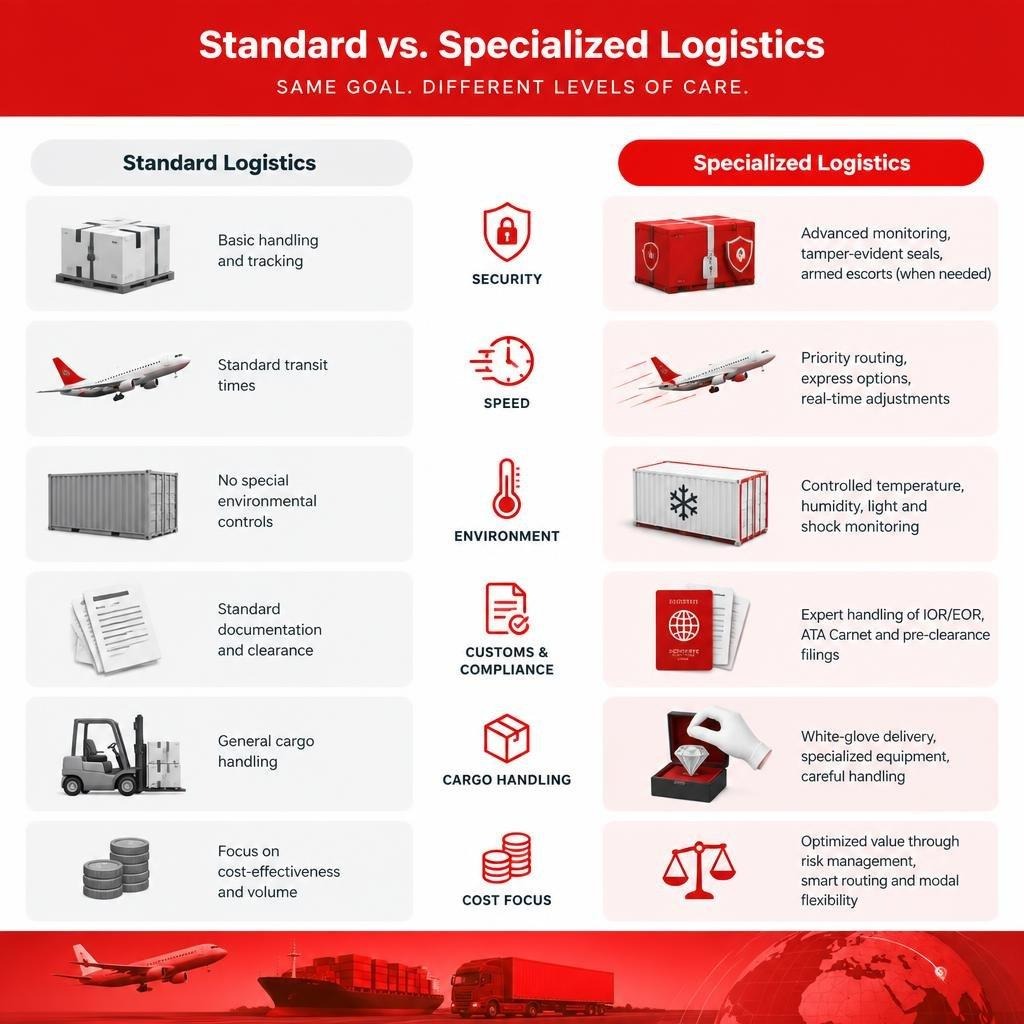
Specialized shipping sets itself apart from standard freight forwarding primarily through its enhanced focus on regulatory oversight, precision routing, specialized equipment, and an unbroken chain of custody. Standard freight typically handles general cargo, prioritizing cost-effectiveness and volume, whereas specialized services cater to items that demand specific environmental controls, accelerated transit times, heightened security, or complex regulatory compliance. This includes sensitive goods like pharmaceuticals, high-value electronics, dangerous goods, and time-critical aerospace components, where failure to meet specific conditions can result in significant loss.
How are dangerous goods handled during international transit?
The handling of dangerous goods during international transit is governed by strict regulations, most notably the IATA Dangerous Goods Regulations for air transport. Logistics providers must possess specific IATA certification, ensuring their staff are expertly trained in the classification, packaging, marking, labeling, and documentation of hazardous materials. Each dangerous goods shipment requires a precise hazardous declaration, detailing its contents, quantity, and hazard class. Furthermore, compliant packaging, designed to safely contain the materials and withstand transit stresses, is mandatory. Finally, rigorous carrier vetting is essential to confirm that all chosen transport partners have the necessary licenses, equipment, and expertise to handle such sensitive cargo safely and legally.
How do companies maintain end-to-end visibility for high-value cargo?
Maintaining end-to-end visibility for high-value cargo is achieved through the integration of advanced technologies and centralized monitoring systems. IoT tracking devices, embedded within or attached to shipments, transmit real-time data on location, temperature, humidity, and other critical environmental factors. These devices often leverage 4G/5G sensors for reliable and continuous data transmission, even in remote areas. All this data is fed into sophisticated control towers, which act as central command centers. These control towers provide a live, comprehensive overview of the entire supply chain, enabling logistics experts to monitor progress, identify potential deviations, and generate predictive exception alerts, allowing for proactive intervention before minor issues escalate into major problems.
Conclusion
In an increasingly interconnected yet volatile global landscape, the importance of specialized shipping and logistics cannot be overstated. As of September 2026, businesses face unprecedented challenges, from supply chain disruptions to heightened security risks and evolving regulatory demands. Specialized logistics solutions provide the strategic agility required to navigate these complexities, ensuring that critical, sensitive, and high-value goods reach their destinations efficiently and securely.
The ability to adapt quickly, implement precise routing, and leverage advanced monitoring technologies is crucial for maintaining supply chain resilience. Forming strong partnerships with specialized carriers who possess the specific expertise, certifications, and infrastructure for complex shipments is no longer a luxury but a necessity. These partnerships ensure operational continuity, safeguarding product integrity and minimizing costly downtime. Investing in specialized shipping and logistics is an investment in reliability, compliance, and the unwavering assurance that your most critical assets are in expert hands, enabling your business to thrive in a demanding global market.