Starting a catering truck business gives you the opportunity to combine good food, independence, and the freedom to take your business directly to customers. From weekday pitches and markets to festivals, weddings, and private functions, a mobile setup can open the door to many different revenue streams.
However, there is a considerable difference between owning a catering truck and running one successfully. Before serving your first customer, you need to think carefully about your concept, menu, equipment, power requirements, branding, and day-to-day operation.
Here is an overview on why getting these foundations right can help turn an exciting idea into a business with genuine staying power.
Develop a Clear Food Concept
Your concept should be one of the first decisions you make. Rather than attempting to cater for everyone, consider what you want your catering truck to become known for.
You might specialize in loaded fries, handmade burgers, wood-fired pizza, breakfast food, desserts, or dishes inspired by a particular cuisine. Alternatively, your focus could be high-quality coffee and quick snacks for commuters and workers.
A clear identity makes the business easier to market and can simplify your operation. A smaller, well-designed menu generally requires fewer ingredients and less equipment while allowing staff to become exceptionally efficient at preparing each item.
Think about your likely customers as well. Food designed for a busy lunchtime pitch may need to be prepared and served within minutes, whereas customers at weddings and private functions may expect a more elaborate offering.
Choose and Design Your Catering Truck
The truck itself is much more than transportation. It is your kitchen, shopfront, storage area, and workplace rolled into one, so its design deserves careful consideration.
Plan the interior around the way food will move through the business. Ingredients should be easy to retrieve, preparation areas need sufficient space, and cooking equipment should be positioned logically. Staff should be able to move safely even when several orders are being prepared simultaneously.
Storage can quickly become an issue in a small mobile kitchen. Make use of shelves, cupboards, and under-counter areas without making the workspace feel overcrowded. Refrigeration, handwashing facilities, ventilation, waste storage, and food preparation areas also need to be incorporated from the beginning rather than squeezed in afterwards.
Work Out Your Power Requirements
Modern catering trucks can depend on a surprising amount of equipment. Refrigerators, freezers, lights, coffee machines, extraction systems, and other appliances all place demands on your electrical supply.
Some trading locations provide electrical hook-ups, but relying exclusively on external power can restrict where you operate, whereas an independent power source may give you greater flexibility when attending outdoor events or trading from pitches without mains electricity.
Calculate the combined requirements of your equipment rather than simply choosing a generator based on price. Businesses exploring suitable options can look at the generator range from Power and Pedal UK when considering how to provide reliable power for a mobile setup.
Remember to consider noise, fuel consumption, physical size, and where the generator will be positioned during service. Your power setup needs to be practical as well as capable of handling demand.
Make Your Truck Part of the Brand
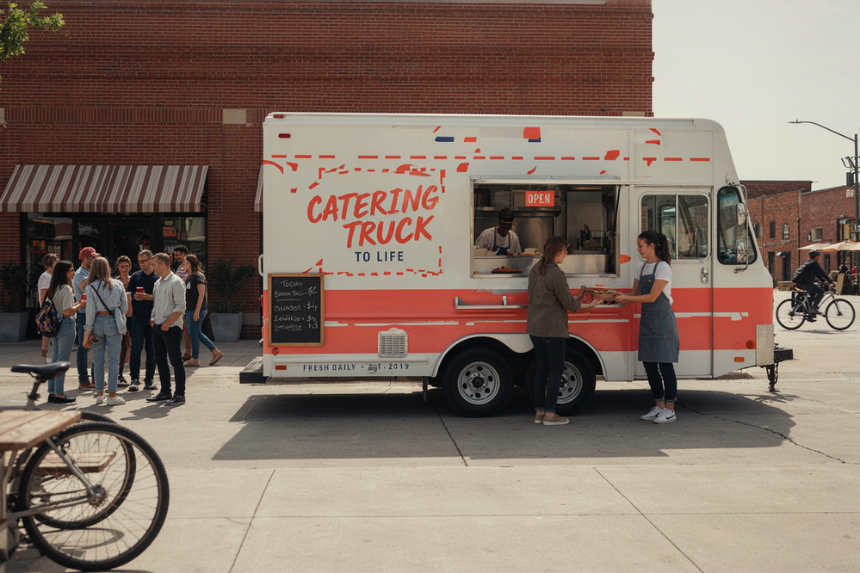
One advantage of operating from a catering truck is that the vehicle itself can become a highly visible advertisement.
Create branding that people can recognise from a distance. A distinctive business name, a clear logo, and consistent visual identity can make your truck easier to remember, particularly at events where numerous food vendors are competing for attention.
Menu boards should also be simple to read. Customers standing in a queue should be able to understand what you sell and how much it costs before reaching the serving window. Complicated menus and unclear pricing can slow down ordering at precisely the time you need customers moving through quickly.
Social media can complement your physical branding. Posting your weekly locations, new menu items, and upcoming events gives customers a reason to follow the business and find you again.
Find the Right Places to Trade
A brilliant menu won’t achieve much without customers, which makes finding suitable pitches an essential part of building the business.
Explore several possibilities rather than depending entirely on one location. Markets, festivals, business parks, sporting events, agricultural shows, weddings, and corporate functions can all provide opportunities.
Evaluate each pitch commercially. High footfall might look attractive, but expensive pitch fees or several competitors selling similar food could reduce its value. Conversely, a modest location with limited competition and a dependable lunchtime crowd might generate consistent sales.
Prepare for Busy Service Periods
Success brings its own challenge: queues. Customers may happily wait for exceptional food, but unnecessary delays can still cost you sales.
Before launching, practice your complete workflow. Run through taking an order, accepting payment, preparing the food, adding extras, and handing it to the customer. Look for points where the process slows down.
Preparation can make an enormous difference. Ingredients, packaging, and utensils should be positioned where they are needed, while responsibilities should be clearly divided when multiple people are working.
Build a Business That Can Grow
Your first truck does not have to represent the finished version of your business. Treat the early months as an opportunity to learn what customers actually want.
Monitor ingredient costs, wastage, pitch fees, fuel, power consumption, and average order values alongside total sales. This gives you a clearer picture of profitability and helps you decide where improvements are needed.
Eventually, growth might mean adding catering packages, attending larger festivals, introducing another truck, or developing additional menu concepts. The important point is to establish a reliable and profitable operation first.
Bringing a catering truck business to life takes considerably more than finding a vehicle and cooking great food. With a distinctive concept, carefully planned workspace, dependable equipment, memorable branding and smart choice of trading locations, however, your mobile kitchen can become a business that customers actively seek out.