Core Frameworks of Digital Marketing and Conversion Optimization
In the ever-evolving digital landscape of September 2026, many businesses are focused on attracting more website traffic. However, we’ve found that the most significant growth opportunities often lie in maximizing the value of the visitors you already have.
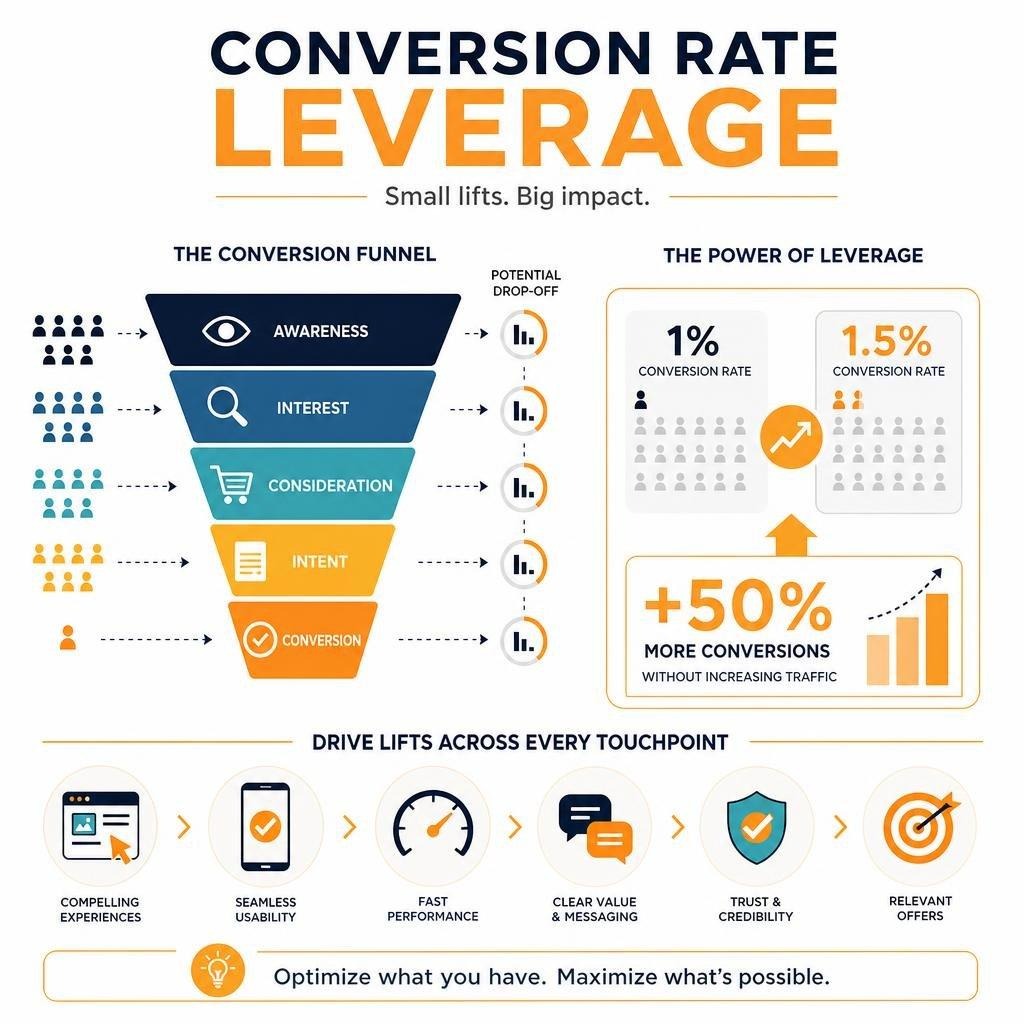
This is where the strategic blend of digital marketing and conversion optimization becomes essential. Instead of constantly increasing ad spend, we can systematically improve how your website or app turns existing traffic into loyal customers and leads. Consider the impact: a website with 100,000 monthly visitors converting at 1% generates a certain revenue. A simple lift to 1.5% – without spending another cent on traffic acquisition – can result in a 50% increase in revenue. This demonstrates the immense leverage of effective optimization.
This systematic approach to enhancing the percentage of users who complete a desired action is known as conversion rate optimization. It’s arguably the highest-leverage activity in digital marketing.
In this extensive guide, we will explore how to integrate these powerful strategies. We’ll delve into understanding conversion funnels, implementing research methodologies, prioritizing tests, and optimizing every touchpoint from landing pages to mobile experiences.
At the heart of effective digital marketing and conversion optimization lies a deep understanding of the user journey. Every visitor to your digital property embarks on a path, often referred to as a conversion funnel, leading towards a desired action. Our primary goal is to identify and seal the “leaks” in this funnel where potential customers drop off.
Mapping this conversion funnel is the critical first step. We begin by documenting each stage a user passes through, from initial awareness to the final conversion event. For an e-commerce site, this might involve steps like “product page view,” “add to cart,” “checkout initiation,” and “purchase completion.” For a lead generation site, it could be “landing page visit,” “form interaction,” and “form submission.” By meticulously tracking entry, exit, and conversion rates at each stage, we can pinpoint the biggest drop-off points. These “leaks” represent the most significant opportunities for optimization.
Beyond just quantitative mapping, we also employ heuristic evaluation, which involves an expert review of your website against established usability principles. This helps us identify potential friction points based on best practices, even before diving into user data. Behavioral analytics then complements this by showing us how users interact with the site. All these efforts are geared towards understanding user intent – what are visitors trying to achieve, and how can we make that process as seamless as possible? Recognizing the difference between macro and micro conversions is also vital here. Macro conversions are the ultimate business goals, like a purchase or a demo request. Micro conversions are smaller, preparatory actions, such as signing up for a newsletter, viewing a key product video, or adding an item to a wish list. Tracking both provides a more complete picture of user engagement and allows us to identify early indicators of success or potential issues within the funnel.
Research Methodologies for Digital Marketing and Conversion Optimization
To truly understand why users behave the way they do, we need to combine both quantitative and qualitative research. Quantitative analysis, often powered by tools like Google Analytics 4 (GA4), provides the “what” – what users are doing, where they’re dropping off, and which segments perform best. GA4’s event-based model and Funnel Exploration reports are invaluable for defining custom event sequences, segmenting users, and analyzing drop-off rates with unprecedented flexibility.
However, quantitative data alone rarely explains the “why.” This is where qualitative research methods become indispensable. We use tools like click heatmaps and scroll maps to visualize where users click and how far they scroll on a page, revealing areas of interest or neglect. Session replays allow us to watch anonymized recordings of user journeys, offering direct insight into their struggles, hesitations, and navigation patterns. On-site surveys and exit-intent surveys capture direct feedback, asking users about their goals, frustrations, or what prevented them from converting. Furthermore, usability testing, whether moderated or unmoderated, involves observing real users as they attempt to complete tasks on your site. This allows us to uncover usability problems and conversion barriers that analytics alone cannot reveal. In fact, research suggests that testing with just five users can surface roughly 85% of usability problems, providing a highly efficient way to gather actionable insights.
Prioritization Models and Testing Protocols
With a wealth of insights from research, the next challenge is deciding what to optimize first. This is where hypothesis frameworks come into play, helping us prioritize potential tests to ensure we focus on the highest-impact opportunities. Common frameworks include:
- PIE Framework (Potential, Importance, Ease): This model scores ideas based on their potential impact on conversion, the importance of the page or section being optimized, and the ease of implementing the test.
- ICE Scoring (Impact, Confidence, Ease): Similar to PIE, ICE evaluates the potential impact of a change, our confidence that the change will yield positive results, and the ease of implementation.
- PXL Matrix: This framework uses a series of binary (yes/no) questions to assess an idea’s potential, providing a more evidence-based approach to prioritization and reducing subjective bias.
Once hypotheses are prioritized, we move to testing protocols, with A/B testing forming the operational core of modern digital marketing services. For robust A/B testing, statistical rigor is paramount. We always determine the minimum detectable effect (the smallest change we want to be able to measure), statistical power (typically 80%, meaning an 80% chance of detecting a true effect), and required sample size before launching a test. It’s crucial to run tests for full business cycles to account for weekly or monthly variations and to avoid common mistakes like early stopping, which can lead to false positives. While A/B testing compares two (or more) versions of a single element, multivariate testing (MVT) allows us to test multiple variables simultaneously to understand how they interact. MVT is best suited for high-traffic pages where you need to understand the combined effect of several changes, though fractional factorial designs can be used for mid-traffic sites to reduce the required sample size.
High-Impact Experience and Funnel Architecture
Optimizing the user experience is central to driving conversions. Every element on a page contributes to or detracts from the user’s ability to complete a desired action.
Lead Capture and Checkout Streamlining
Forms and checkout processes are notorious for high abandonment rates, making them prime targets for conversion optimization. For lead generation, the goal is to reduce friction as much as possible. This often means reducing fields to only the absolute essentials. We’ve seen that reducing a form from 11 fields to 4 can lift completions by more than 100%. For longer forms, employing multi-step forms with clear progress indicators can make the process less daunting. Progressive profiling, where you gather additional information from users over time rather than all at once, is another effective strategy.
For e-commerce, industry checkout abandonment rates routinely sit around 70%, highlighting a massive opportunity. Key optimization tactics include offering guest checkout to remove the barrier of account creation, implementing address autocomplete to speed up data entry, and providing multiple trusted payment gateways. A robust and timely abandoned-cart recovery sequence can also bring back a significant percentage of lost sales. Finally, exit-intent overlays can be a powerful tool to recover lost visitors, but they must be used judiciously. They should trigger only when a user is about to leave, offer a relevant and compelling incentive (e.g., a discount, a valuable resource), and be easy to dismiss to avoid frustrating users. On mobile, where exit intent detection is less reliable, alternative strategies should be considered.
Technical Performance, Mobile UX, and Personalization
In September 2026, mobile devices account for the majority of web traffic, yet often a minority of conversions. This makes mobile UX the largest unexploited CRO opportunity. Slow loading times, small tap targets, and intrusive pop-ups can quickly deter mobile users. We prioritize optimizing Core Web Vitals (Largest Contentful Paint, First Input Delay, Cumulative Layout Shift) as they directly impact user experience and search engine rankings. Each additional second of load time can significantly reduce conversion rates, especially after 2-3 seconds. Tactics like image compression, lazy loading, and script minification are crucial. Furthermore, ensuring large, easily tappable elements and designing for thumb-friendly navigation are essential. For businesses targeting specific geographic areas, optimizing for local search rankings on mobile devices is paramount, as users often search for nearby services or products while on the go.
Beyond foundational UX, personalization complements A/B testing to drive additional conversion lift. By segmenting users based on their audience characteristics, behavioral patterns, or lifecycle stage, we can serve tailored experiences. This could involve dynamic content that changes based on a user’s previous interactions, location, or referral source. While advanced behavioral personalization requires careful testing, starting with simpler, low-cost geographic or lifecycle-based personalization can yield significant results.
Strategic Execution and Program Governance
Effective CRO is not a one-off project but an ongoing, iterative process that requires robust strategic execution and program governance.
Aligning Digital Marketing and Conversion Optimization for B2B vs. B2C
The approach to CRO differs significantly between B2B and B2C contexts. In B2C, the focus is often on maximizing lead quantity and sales volume, reducing friction to drive immediate purchases, and optimizing for average order value. The sales cycle is typically shorter, and decisions are often more impulsive.
In B2B, however, the emphasis shifts to lead quality over sheer quantity. The sales cycle is longer, involves multiple stakeholders, and the value of a single converted lead can be substantial. Therefore, B2B CRO might intentionally introduce “qualification friction” – such as adding more fields to a form or requiring specific company information – to ensure that only highly qualified leads enter the sales pipeline. This might reduce the total number of submissions but significantly improves pipeline velocity and the efficiency of the sales team, ultimately lowering the customer acquisition cost for valuable clients.
Sustainable Experimentation and Channel Integration
Building a sustainable, long-term CRO program means embedding an experimentation culture within your organization. This involves creating an experimentation roadmap, a structured plan for testing hypotheses over time, and maintaining a knowledge repository to document all test learnings, both wins and losses. This ensures that insights compound over time, preventing us from repeating past mistakes and accelerating future optimizations.
Test governance is crucial to ensure statistical rigor, proper tracking, and effective communication of results. We also continuously monitor guardrail metrics – secondary metrics that ensure our optimizations don’t negatively impact other important aspects of the business (e.g., increasing conversion at the expense of average order value). A common mistake is treating CRO in isolation. Instead, it must be integrated with other digital marketing channels. Insights from CRO can inform SEO strategies, paid media campaigns, email marketing, and content development, ensuring a cohesive and optimized customer journey across all touchpoints. This holistic approach, often facilitated by integrated marketing solutions, breaks down data silos and ensures that learnings from one area amplify results across the entire marketing ecosystem.
Frequently Asked Questions About Conversion Strategy
We often encounter common questions about conversion strategy, particularly regarding the practicalities of experimentation.
How long does an experimentation cycle take to yield statistical significance?
The duration of an experimentation cycle depends on several factors: your website’s traffic volume, the minimum detectable effect you’re trying to measure, and the desired statistical power. High-traffic pages with a clear, impactful change might reach significance in a week or two. Lower-traffic pages or subtle changes could take several weeks, or even a few months. It’s also important to run tests for at least one full business cycle (e.g., a week for B2C, or a month for B2B) to account for day-of-week or seasonal variations.
What is the minimum traffic required to run valid A/B tests?
While there’s no single “magic number,” a general guideline is at least a few thousand conversions per month on the page or funnel step you’re testing to run statistically significant A/B tests. For sites with lower traffic, directly testing macro conversions might be challenging. In such cases, we often focus on optimizing micro-conversions, which have higher volumes and can provide earlier statistical significance. Additionally, qualitative diagnostics, heuristic audits, and user testing become even more critical for lower-traffic sites to identify major usability issues before attempting A/B tests that might be underpowered.
How does page speed directly influence conversion metrics?
Page speed and Core Web Vitals directly impact conversion rates by affecting user experience. A slow-loading page increases bounce rates and user frustration. For every additional second of load time, especially beyond 2-3 seconds, conversion rates can drop significantly. On mobile, this effect is even more pronounced due to varying network conditions. Core Web Vitals, such as Largest Contentful Paint (LCP), First Input Delay (FID), and Cumulative Layout Shift (CLS), measure key aspects of loading performance, interactivity, and visual stability. Improving these metrics leads to a smoother, more pleasant user experience, which in turn reduces abandonment and encourages users to complete their desired actions.
Conclusion
In September 2026, the synergy between digital marketing and conversion optimization is no longer optional; it’s a fundamental driver of sustainable business growth. By embracing an experimentation culture, meticulously mapping conversion funnels, and continuously iterating based on data-backed insights, businesses can achieve compounding returns on their existing traffic. Focusing on full-funnel efficiency, from the initial touchpoint to the final conversion, ensures that every marketing dollar spent works harder, transforming visitors into loyal customers and maximizing profitability without simply chasing more traffic.