
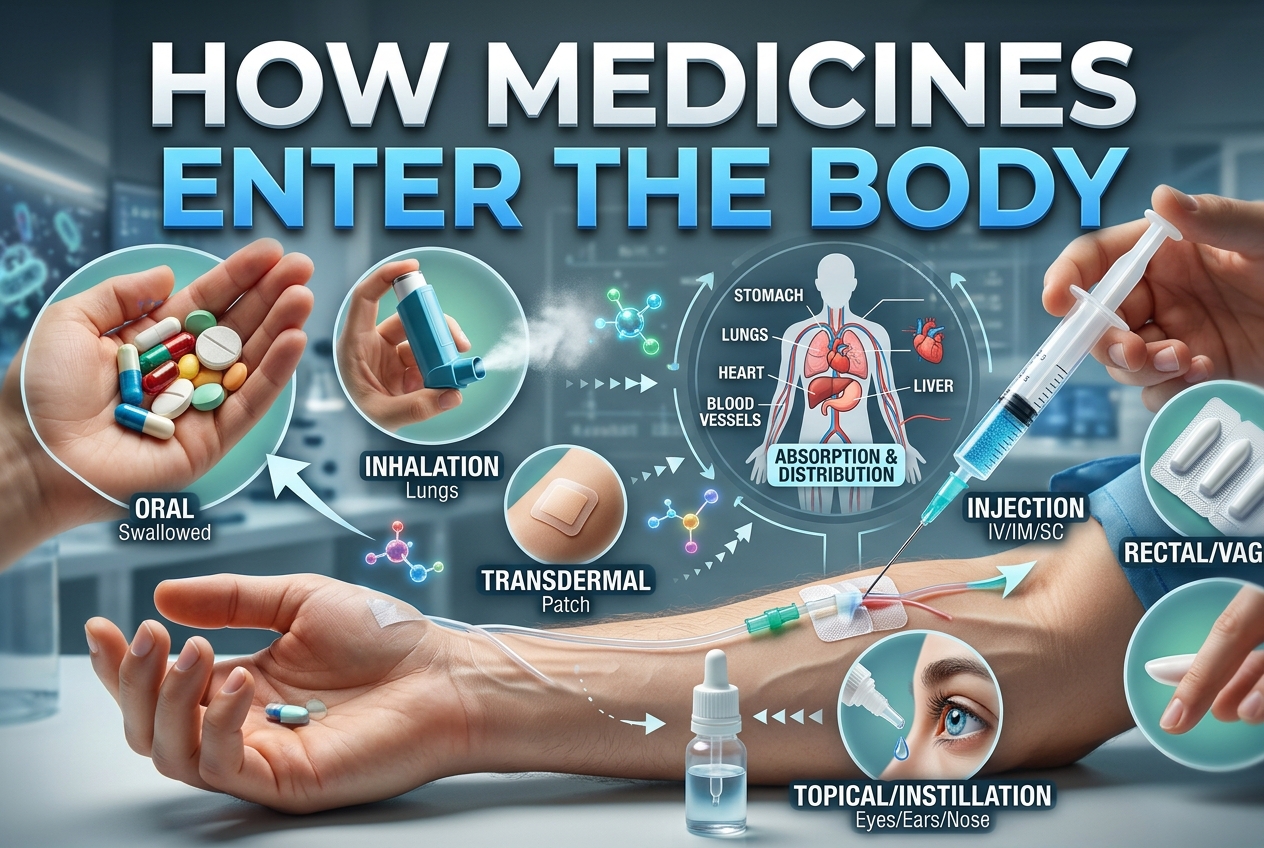
Swallowing a tablet seems like one of the simplest things in modern healthcare. You take it with a glass of water, carry on with your day, and expect the medicine to do its job. Yet between swallowing that tablet and experiencing its effects, an extraordinary series of biological processes takes place.
The human body doesn’t automatically absorb everything that enters the digestive system. Medicines must overcome several barriers before reaching the bloodstream, and some compounds struggle to get through at all. Understanding these challenges is an important part of pharmaceutical research, helping scientists develop treatments that are both effective and safe.
What Happens After You Swallow a Tablet?
When a tablet enters the digestive system, it usually needs to break apart and release its active ingredients. Those ingredients must then dissolve in gastrointestinal fluids before they can be absorbed.
The stomach plays an important role in this process, although many medicines are absorbed primarily in the small intestine.
This is partly because the small intestine has an enormous surface area created by tiny projections called villi and microvilli. These structures provide extensive contact between digested substances and the cells lining the intestinal wall.
However, reaching the intestine doesn’t guarantee that a medicine will enter the bloodstream. Its chemical properties, stability, and ability to cross biological membranes all influence what happens next.
The Intestinal Barrier Is Surprisingly Selective
The cells lining the intestine act as a protective barrier, allowing certain substances to pass through while restricting others.
Some drug molecules move directly through cell membranes, particularly when their chemical characteristics allow them to dissolve in the membrane’s fatty structure. Others depend on specialized transport proteins that help move substances across intestinal cells.
The body also contains proteins capable of transporting certain compounds back towards the intestinal contents, potentially reducing the amount of medicine absorbed. These mechanisms help explain why two medicines taken in similar doses can behave very differently once swallowed.
How Scientists Study Drug Absorption
Before a new medicine reaches clinical trials, researchers need to understand how it might behave inside the digestive system.
Laboratory cell models provide one way to investigate these questions without immediately conducting studies in humans. For example, CACO2 from Cytion provides a human colorectal cancer-derived cell line commonly used in intestinal absorption research. Under appropriate culture conditions, these cells can develop characteristics resembling certain intestinal epithelial cells.
Scientists can grow them in controlled laboratory systems to investigate how experimental compounds move across a cellular barrier. These experiments provide useful information about potential intestinal permeability, but they cannot reproduce every aspect of human digestion. Researchers must therefore combine laboratory findings with other experimental approaches.
Why Some Medicines Work Better With Food
You’ve probably noticed that certain medicines should be taken with meals, while others work best on an empty stomach. These instructions aren’t arbitrary. Food can influence how quickly the stomach empties, how a medicine dissolves, and how it interacts with substances in the digestive system.
For some medicines, eating can improve absorption. For others, food may delay absorption or reduce the amount entering circulation. Certain foods and supplements can also interact with medicines. Calcium, for example, can interfere with the absorption of some antibiotics.
This is why following the instructions provided with a prescription or medicine is important, even when the reason isn’t immediately obvious.
The Liver Adds Another Complication
Absorption isn’t the end of the journey. Many substances absorbed from the intestine travel through the portal circulation to the liver before reaching the wider bloodstream.
The liver contains enzymes that can chemically modify medicines, sometimes breaking down part of a dose before it reaches its intended destination. This process contributes to what’s known as first-pass metabolism.
Some medicines are extensively metabolized during this initial journey, meaning only a proportion of the swallowed dose reaches systemic circulation unchanged. Pharmaceutical scientists consider this when determining suitable doses and developing different methods of administering medicines.
Why Drug Formulation Matters
The active ingredient is only one part of a medicine. The way it’s formulated can have a significant influence on how it behaves inside the body. Tablets, capsules, liquids, and modified-release preparations are designed to deliver medicines in different ways.
Some formulations protect sensitive ingredients from stomach acid, while others release their contents gradually to maintain drug concentrations over a longer period.
Scientists may also investigate techniques that improve the dissolution of compounds that don’t dissolve easily in water. These developments can make existing medicines easier to administer or help improve the performance of promising new treatments.
What This Means for Future Treatments
Understanding drug absorption is particularly important when developing medicines intended to be taken orally. Researchers must consider whether a compound can survive digestion, cross the intestinal barrier, and reach its intended target in sufficient quantities.
Advances in cell culture, computer modeling, and pharmaceutical formulation are helping scientists investigate these challenges earlier in drug development. However, laboratory predictions still require careful evaluation through appropriate clinical studies before conclusions can be drawn about how a medicine performs in patients.
A Remarkable Journey Hidden Inside an Everyday Routine
Taking a tablet might require only a few seconds, but the biological processes that follow are remarkably complicated. From dissolving in digestive fluids to crossing intestinal cells and passing through the liver, medicines encounter several obstacles before producing their intended effects.
Understanding these processes helps researchers develop better formulations, investigate potential interactions, and improve how treatments are delivered.
The next time you take a medicine, it’s worth remembering that something seemingly ordinary depends on an extraordinary amount of biology, chemistry, and scientific research.