Flying private is usually discussed as one thing. It is really three, and the differences are financial rather than experiential. The aircraft can be identical across all three. What changes is how much money leaves your account before you ever board, and what you are committed to afterwards.
On-demand charter is the only option that asks for nothing upfront
You book a specific aircraft for a specific trip, pay for that trip, and owe nothing afterwards. No deposit, no membership, no contract.
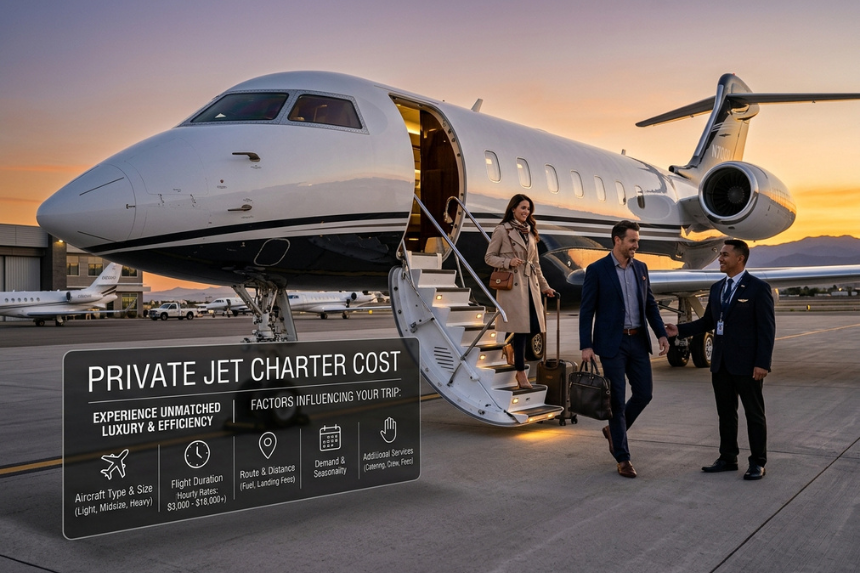
Published 2026 rate guides put hourly charter pricing roughly in these bands: turboprops around $2,300 to $3,500 an hour, light jets around $3,750 to $4,200, midsize jets around $4,700 to $5,500, super-midsize around $6,200 to $7,500, large-cabin jets around $8,500 to $10,000, and ultra-long-range aircraft anywhere from $12,000 to $17,000. Actual quotes move with fuel prices, routing and season.
The advantage is flexibility. Different trip, different aircraft – a light jet for a two-hour hop, a large-cabin jet for a transatlantic leg – with no penalty for switching. Brokers working in this lane, Trilogy Aviation Group among them, source each aircraft per trip from a network of independent operators rather than flying a fleet of their own, which is what makes that flexibility possible in the first place.
Jet cards trade a large deposit for a locked hourly rate
A jet card is prepaid flight time. You buy a block of hours – 25 is a common minimum – at a rate fixed when you purchase. Industry guides put typical upfront outlay somewhere between $150,000 and $300,000 depending on aircraft category and hours.
What you are buying is predictability. The rate does not move with the market, availability is guaranteed within a set call-out window, and booking is faster because the commercial terms are already agreed.
The terms are where cards differ most. Some programmes let hours expire, others do not. Some refund unused hours, others do not. Some apply peak-day surcharges and blackout dates, others advertise the absence of them as the selling point. Two cards at the same headline rate can be very different products.
Fractional ownership is an asset purchase with a travel benefit attached
Fractional means buying a share in a specific aircraft. A representative structure: a 12.5% share on a large-cabin type costs around $1.25 million in capital and entitles the owner to roughly 50 flight hours a year over a three-year term, with a guaranteed buyback at a set percentage of the original share value at the end.
On top of the capital there is a monthly management fee covering crew, maintenance, hangarage and insurance, plus an occupied hourly rate every time you fly.
This is a balance-sheet decision, not a travel booking. It also carries a cost that surprises people: comparisons across the sector consistently note that the effective hourly cost of fractional flying can run well above the equivalent charter rate once management fees are counted, with the capital commitment layered underneath.
The advertised hourly rate is never the final number
Regardless of the model, the quote includes items the hourly figure leaves out. In the US, domestic charter carries a 7.5% federal excise tax plus a per-segment fee. Beyond that: repositioning or ferry time when the aircraft is not already where you are, overnight crew expenses on multi-day trips, landing and handling fees, de-icing in winter, catering, and international handling or customs fees on cross-border legs.
A quote that looks unusually low next to others is usually a quote with fewer of these included.
How many hours you fly a year decides this more than anything else
Industry comparisons converge on rough thresholds. Under about 25 hours a year, on-demand charter tends to win because there is no capital sitting idle. From roughly 25 to 75 hours, jet cards start earning their deposit through rate certainty and faster booking. From about 75 to 200 hours, fractional structures become defensible. Above 200 hours, full ownership enters the conversation.
These are guidelines rather than rules, and the honest version is that most people overestimate their number. Flight hours are easy to project optimistically and harder to actually fly.
Empty leg flights are the exception that breaks the pricing logic
When an aircraft has to reposition – flying to collect passengers, or returning to base after a drop-off – that leg would otherwise fly empty. Operators sell those seats at a substantial discount to recover something.
The catch is total inflexibility. The route is fixed, the date is fixed, the timing is set by someone else’s itinerary, and the flight can disappear if the original booking changes. For travel that can bend around an aircraft’s schedule, empty legs are the cheapest private flying available. For anything with a fixed obligation at the other end, they are unreliable by design.
The safety checks matter more than the price comparison
Charter flights in the US are flown under FAA Part 135 rules, which is the regulatory floor rather than a quality rating. Independent auditors sit above it: ARGUS and Wyvern both assess operators on maintenance records, pilot experience and operational history, and brokers can hold their own registered or certified status.
Practical questions worth asking before booking with anyone: who audits the operator flying this aircraft, what is its rating, how many pilots are on the flight deck, and what liability insurance is carried on the aircraft. Any credible broker answers these directly. Hesitation is the answer.
The comparison that actually matters
Charter, cards and fractional shares are not tiers of the same product with luxury increasing as you go up. They are three different financial commitments that produce the same flight. The question is not which is best – it is how many hours you genuinely fly, how much capital you want tied up, and how much flexibility you are willing to give away in exchange for a fixed rate.
For most travellers, the answer is fewer hours than expected, no capital, and full flexibility. That points to one option.