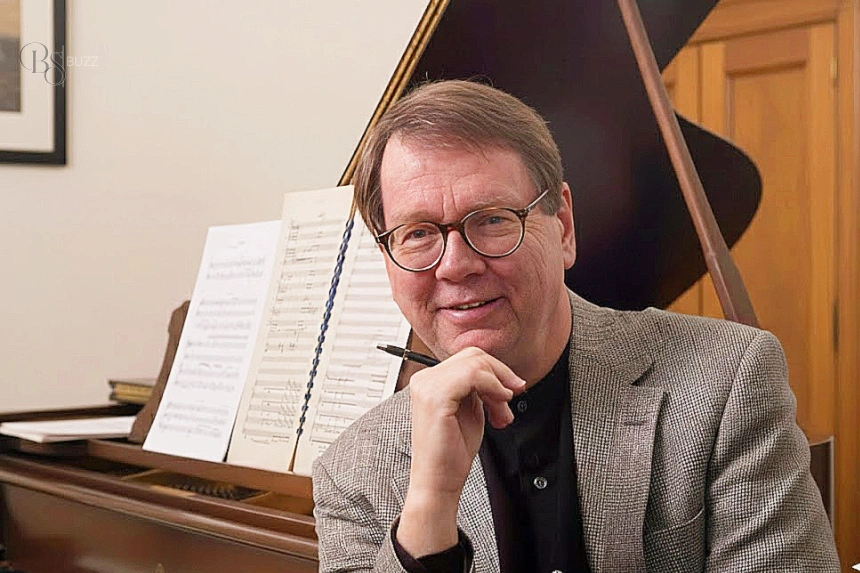
How a life in academia shaped Jackson Hill’s contributions to contemporary music.
Jackson Hill stands as a distinctive figure in American contemporary music, a composer, scholar, and educator whose career spans rigorous academic research, international cultural exploration, and a substantial body of original compositions. Best known for his symphonic and choral works, Hill’s music reflects a rare synthesis of Western modernism, Renaissance polyphony, and Japanese musical traditions.
Born in 1941, Jackson Hill’s journey offers insight into how intellectual curiosity, cross-cultural study, and sustained teaching can shape a meaningful artistic legacy. His work exemplifies how composition can function not merely as creative expression, but as scholarly inquiry and cultural dialogue.
Facts: Jackson Hill
| Facts | Details |
| Full Name | Jackson Hill |
| Born | 1941 |
| Birthplace | Birmingham, Alabama, United States |
| Nationality | American |
| Profession | Composer, music scholar, educator |
| Primary Genres | Symphonic, choral, chamber, contemporary classical |
| Known For | Choral compositions and academic contributions to music |
| Early Musical Activity | Began composing at age 14 |
| Undergraduate & Doctoral Education | University of North Carolina at Chapel Hill |
| Highest Degree | Ph.D. in Musicology (1970) |
| Doctoral Focus | Dutch twentieth-century twelve-tone music |
| Composition Teachers | Iain Hamilton; Roger Hannay |
| International Study | Oxford University; Cambridge University; Fulbright Fellow in Japan |
| Japanese Studies | Buddhist chant and traditional Japanese court music |
| Primary Academic Appointment | Bucknell University |
| Years at Bucknell | 1968–2008 |
| Academic Roles | Professor of Music, Department Chair, Associate Dean |
| Special Honors | Presidential Professor; Faculty Emeritus |
| Major Symphonies | Sinfonia Nipponica, Canonica, Romantica |
| Notable Choral Works | Voices of Autumn (1982), In Winter’s Keeping (2001) |
| Grammy Recognition | Voices of Autumn featured on a Grammy-nominated recording |
| Commissioning Ensembles | Chanticleer, The King’s Singers, Fitzwilliam String Quartet |
| Festival Performances | Tanglewood, Ravinia, Chautauqua, Edinburgh |
| Professional Affiliations | ASCAP; Society of Composers |
| Vocal Range | Countertenor |
| Musical Influences | Renaissance polyphony; Japanese traditional music |
| Current Status | Retired (Faculty Emeritus) |
Early Life and Musical Awakening
Jackson Hill was born in Birmingham, Alabama, in 1941 and spent much of his youth in North Carolina. His early environment exposed him to music at a formative age, and by fourteen, Hill was already composing, an early sign of the discipline and intellectual engagement that would characterize his later career.
Unlike many composers whose early paths are performance-driven, Hill’s inclination leaned toward structure, theory, and the underlying logic of music. This analytical bent would later guide him toward advanced study in musicology and composition, laying the foundation for a career that consistently balanced creativity with scholarship.
Academic Foundations and Advanced Education
Hill’s formal education reflects an unusually broad and rigorous academic scope. He was awarded the prestigious Morehead Scholarship at the University of North Carolina at Chapel Hill, where he pursued undergraduate and doctoral studies. In 1970, he completed a Ph.D. in musicology, focusing his dissertation on twentieth-century Dutch twelve-tone music—a topic that required both historical fluency and analytical precision.
Complementing his musicological work, Hill pursued intensive composition studies. From 1964 to 1966, he studied under British composer Iain Hamilton at Duke University, followed by advanced composition training with Roger Hannay from 1967 to 1968. These formative years exposed Hill to serialism, modernist techniques, and contemporary compositional thought, all of which would inform, but never confine, his later musical voice.
International Study and Cultural Expansion
One of the most defining aspects of Jackson Hill’s development was his immersion in international musical traditions. His academic curiosity led him to the United Kingdom, where he served as a choral assistant at Exeter College, Oxford, and later as a visiting fellow at Clare Hall, Cambridge. During this period, Hill deepened his engagement with Renaissance and early choral repertoire, sharpening his contrapuntal sensibility.
In the mid-1970s, Hill received a Fulbright Fellowship to Japan, an experience that profoundly reshaped his compositional outlook. There, he studied Buddhist chant and traditional Japanese court music, absorbing not only new scales and tonal systems but also a philosophical approach to sound and time. This exposure introduced elements of pentatonicism, spaciousness, and meditative pacing into his work, creating a sense of “timelessness” that became a hallmark of his later compositions.
A Four-Decade Academic Career at Bucknell University
Hill’s professional life became closely associated with Bucknell University, where he joined the faculty in 1968. Over the next forty years, he taught composition, theory, and music history, shaping generations of students through both instruction and mentorship.
Beyond teaching, Hill played a central role in institutional leadership. He served as Associate Dean, chaired the Music Department, conducted the university orchestra, and was ultimately named a Presidential Professor, one of the institution’s highest academic honors. His long tenure helped establish Bucknell as a serious center for compositional study, particularly during a period when academic music was undergoing significant stylistic and philosophical shifts.
Hill retired in 2008 as faculty emeritus, leaving behind a legacy defined not only by his own music but by the countless students he guided toward thoughtful, disciplined musicianship.
Compositional Output and Musical Style
Jackson Hill’s compositional catalog is extensive and diverse, spanning orchestral, chamber, solo, and choral works. He is particularly recognized for his contributions to the choral repertoire, where his synthesis of Western polyphony and non-Western tonal influences finds its most refined expression.
In the 1990s, Hill composed three full symphonies, Sinfonia Nipponica, Canonica, and Romantica. These works illustrate his mature orchestral voice, blending structural clarity with expressive depth. Chamber works such as Trio da Camera, Threnody, and Ghosts further demonstrate his sensitivity to texture and instrumental color.
Hill’s choral compositions remain his most widely performed. Works like Voices of Autumn (1982) and In Winter’s Keeping (2001) set English, Latin, and Japanese texts within rich harmonic frameworks. His choral writing often emphasizes clarity of text, balanced voicing, and contrapuntal elegance, qualities that make his music both intellectually satisfying and emotionally resonant.
Awards, Performances, and International Recognition
Throughout his career, Jackson Hill has received numerous awards and honors recognizing his contributions to contemporary music. His works have been performed internationally across Europe, Asia, and the Americas, appearing at prominent festivals such as Tanglewood, Ravinia, Chautauqua, and Edinburgh.
Hill’s music has also attracted the attention of leading professional ensembles. He has received commissions from the Fitzwilliam String Quartet, Lichfield Cathedral, New York Polyphony, and major British choral festivals. Vocal ensembles such as Chanticleer and The King’s Singers have performed and commissioned his work, underscoring his reputation as a composer deeply attuned to the vocal idiom.
Grammy Recognition and Recorded Legacy
One of the most notable milestones in Hill’s career came through his choral piece Voices of Autumn. A recording by the Grammy-winning ensemble Chanticleer was included on a 2003 album that received a Grammy nomination. This recognition was particularly significant, as it highlighted the work of a university-based composer within a highly competitive professional field.
Beyond this nomination, Hill’s compositions have been recorded on respected classical labels, ensuring that his music remains accessible to performers, scholars, and listeners worldwide. These recordings serve as an essential extension of his legacy, preserving interpretations of works that might otherwise remain confined to academic circles.
Media Presence and Scholarly Recognition
Although Jackson Hill has maintained a relatively low public profile, his presence within scholarly and professional music communities is well established. He maintains an official website documenting his biography and complete works list. His music and career have been discussed in interviews on classical radio programs, including WWFM’s Sounds Choral and WVIA’s ArtScene.
Hill is also listed in major reference works such as The New Grove Dictionary of Music and Musicians, ASCAP symphonic catalogues, and international directories of composers. These entries confirm his standing as a composer whose work holds lasting academic and artistic significance.
Personal Interests and Artistic Identity
Hill’s personal interests are deeply intertwined with his compositional identity. A countertenor himself, he possesses an intimate understanding of vocal production and ensemble balance. His admiration for Elizabethan and Renaissance polyphony informs the contrapuntal clarity found throughout his choral writing.
Equally influential is his lifelong engagement with Japanese music and culture. Rather than treating these elements as surface-level exoticism, Hill integrates them structurally, allowing Eastern concepts of time, space, and tonal organization to reshape Western forms. This approach results in music that feels contemplative, disciplined, and culturally respectful.
Professionally, Hill has been affiliated with organizations such as ASCAP and the Society of Composers, reflecting his active participation in the broader American compositional community.
Enduring Legacy of Jackson Hill
Jackson Hill’s legacy is defined not by celebrity, but by substance. His career demonstrates how a composer can successfully unite scholarship, teaching, and creative output without compromising depth or integrity. Through decades of academic service, international study, and disciplined composition, Hill has contributed a body of work that continues to inform performers, students, and scholars alike.
In an era often driven by immediacy and visibility, Jackson Hill represents a quieter but enduring model of artistic achievement, one grounded in curiosity, cultural exchange, and intellectual rigor. His music, shaped by both Western tradition and global perspective, remains a testament to the enduring power of thoughtful, informed composition.