
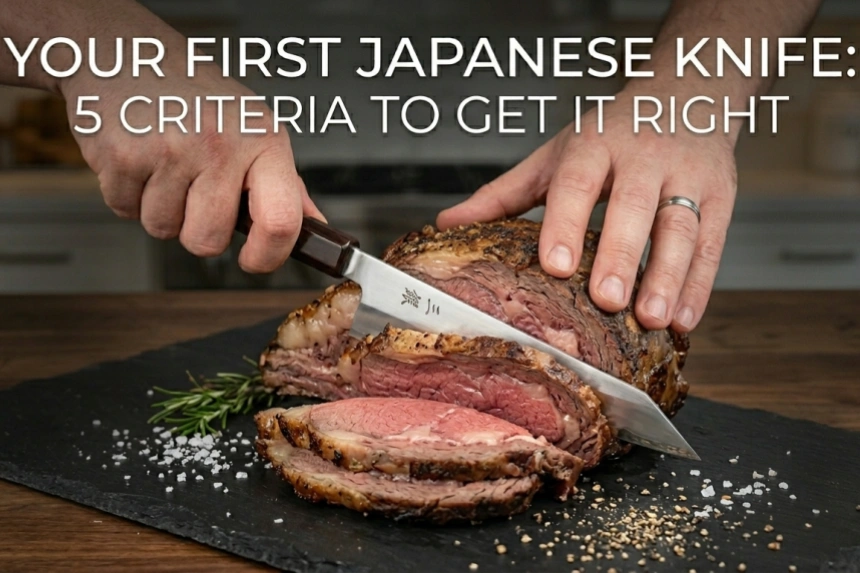
There’s something special about the first time you hold a real Japanese knife. The blade is thin, light, and almost silent on the cutting board. And the carrot falls cleanly in two, without effort. It isn’t magic. It’s metallurgy, generations of craftsmanship, and a design built around efficiency rather than appearance. If you’re wondering how to make the jump without ending up with the wrong model, this guide is for you.
1. Understand What Makes a Japanese Knife Different
Before we talk about models or budget, it helps to understand why Japanese knives perform differently. The steel is harder, often between 60 and 65 HRC on the Rockwell scale, compared to 52 to 58 for a standard Western knife. That hardness allows for a sharper edge angle, typically between 12 and 15 degrees per side, which produces a finer, more precise cutting edge that holds longer between sharpenings.
The blade is also lighter and thinner. Over a 30-minute prep session, that difference is felt in your wrists, your shoulders, and, above all, in the quality of the cut. Tomatoes stop tearing. Herbs stop bruising. Onions come off the board in clean, even slices.
2. Choose the Right Size on Your First Purchase
This is the most common beginner mistake: buying too big or too small relative to how you actually cook. For a standard home kitchen, the 165-180 mm range handles 90% of daily tasks. It’s versatile, manageable, and fits most cutting boards.
The 210 mm format and larger are excellent, but they require a bit more counter space and technique to feel truly comfortable. Save that size for a second knife, once you know your own hand and rhythm.
3. Stainless, Semi-Stainless, or Carbon: Choose Based on How You Actually Cook
Steel type is the most important decision, and it’s the one nobody spells out clearly for beginners. Here’s the direct version.
If you don’t want to worry about special maintenance, choose stainless or semi-stainless steel. Ginsan, also known as Silver Steel #3, is the best compromise in this category: nearly as rust-resistant as standard stainless, with noticeably better edge retention. It’s the recommended choice for a first artisan Japanese knife.
Carbon steels like Shirogami and Aogami offer an exceptional edge but demand a strict routine: dry immediately after use, never put in the dishwasher, and lightly oil if stored for long periods. It’s the right choice for the passionate cook who wants to progress. Not the best entry point.
4. Budget: How Much to Invest Without Regret
The “cheap one just to test it out” temptation is understandable, but it usually leads to a poor first impression. A knife under $80 will show you the shape and feel of the Japanese format, but not its real performance.
The sweet spot for a first artisan knife sits between $150 and $300 CAD. In that range, you get access to authentic forges, documented, high-quality steels, and blades that last 10 to 15 years with minimal care. It’s an investment, not an expense.
Above $300, you move into specialized carbon steels and advanced forge finishes. That speed is absolutely justified, but after the first knife, not before.
5. Hold the Knife Before You Buy It
Product photos only tell you so much. The balance of a knife, the feel of the handle in your palm, the weight of the blade, none of that translates through a screen. If you have the option to see and hold the models in person before buying, take it. The difference between a traditional octagonal WA handle and a Western YO handle registers in three seconds in a boutique, and takes three weeks to get used to if you bought without testing.
In Summary
The best Japanese knife for a beginner isn’t the most expensive or the best-known. It’s the one that matches your hand size, cooking frequency, and maintenance tolerance. Take the time to figure out those three parameters before looking at specific models, and the rest follows naturally.
Have you already made the jump to a Japanese knife? What was your first model, and what would you do differently? Share your experience in the comments. That kind of feedback genuinely helps new buyers avoid the classic mistakes.