
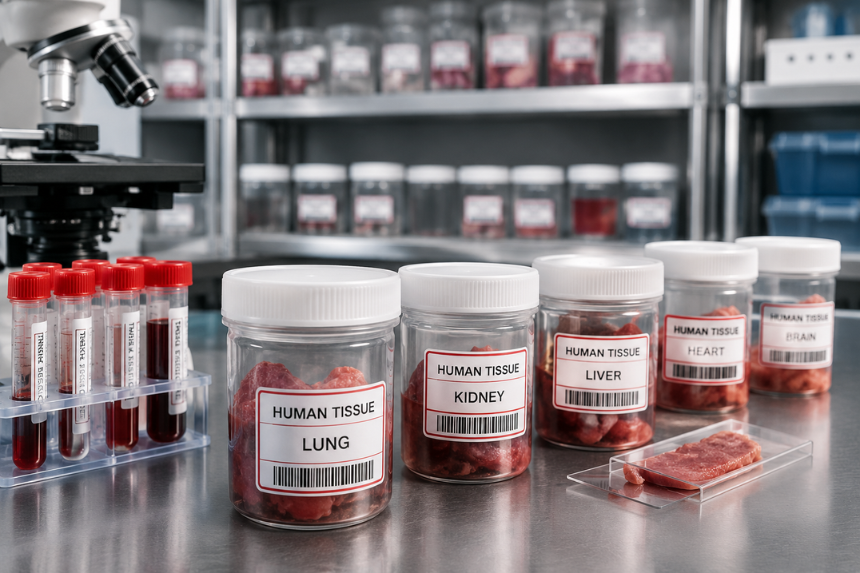
Human biological materials play a major role in scientific research, diagnostic studies, and pharmaceutical development. Researchers study different tissue categories to understand cellular structure, organ function, and disease behavior with greater clarity. Careful examination of these materials supports laboratory investigations across several medical disciplines.
Medical laboratories collect and preserve specimens through regulated procedures that maintain sample quality and research accuracy. Different forms of tissue samples provide valuable information related to genetics, immunity, infection, and cellular response. Strong biological diversity allows scientists to conduct specialized studies that support advanced biomedical discoveries.
Biofluids and Cellular Samples in Research
Biofluids serve as essential biological resources for diagnostic testing and therapeutic investigations. Blood, plasma, serum, saliva, cerebrospinal fluid, and urine contain proteins, enzymes, hormones, and genetic material that reveal important health information. Researchers examine these specimens to study disease progression, immune activity, and treatment response patterns.
Cellular materials also support laboratory evaluations related to drug development and regenerative medicine. Scientists isolate individual cells to examine growth patterns, genetic mutations, and biochemical reactions under controlled conditions. Accurate cellular analysis helps researchers identify abnormalities linked with chronic and infectious diseases.
Epithelial Tissue and Its Scientific Importance
Common Features of Epithelial Tissue
- Epithelial tissue covers body surfaces and lines internal organs and cavities.
- Protective functions help shield organs from harmful substances and infections.
- Absorption and secretion activities support digestive and glandular functions.
- Skin tissue, glandular tissue, and intestinal lining belong to this category.
Researchers frequently examine epithelial specimens during cancer studies because many tumors originate within epithelial cells. Microscopic analysis helps scientists identify abnormal cellular structures and tissue damage linked with disease development.
Connective Tissue and Structural Support
Connective tissue forms the structural framework that supports organs, muscles, and blood vessels throughout the body. Bone, cartilage, fat tissue, tendons, ligaments, and blood belong to this category. Researchers study these materials to understand inflammation, tissue repair, and musculoskeletal disorders.
Important Roles of Connective Tissue
- Bone specimens support orthopedic and metabolic research studies.
- Cartilage samples assist investigations related to joint degeneration and arthritis.
- Adipose tissue contributes to obesity and hormonal research projects.
- Blood-based connective tissue supports immune response and circulation analysis.
Scientific evaluations involving connective tissue help researchers understand structural abnormalities and cellular interactions within the body.
Muscle Tissue and Functional Movement
Muscle tissue controls movement, posture, and organ function through coordinated contraction and relaxation processes. Skeletal muscle supports body movement, cardiac muscle controls heart activity, and smooth muscle regulates internal organ functions. Researchers analyze these tissue samples to study muscular disorders, cardiac conditions, and metabolic diseases.
Laboratory studies involving muscle specimens help scientists evaluate cellular damage, oxygen usage, and protein activity. Detailed analysis supports research related to muscular dystrophy, heart disease, and age-related degeneration. Proper preservation methods maintain structural integrity for accurate scientific interpretation.
Nervous Tissue and Communication Systems
Nervous tissue forms the communication network responsible for sensory processing, coordination, and signal transmission throughout the body. Brain tissue, spinal cord material, and peripheral nerve specimens help researchers study neurological disorders and cognitive conditions. Scientists examine these samples to understand neuron activity and nerve cell degeneration. Research involving nervous tissue contributes to studies focused on Alzheimer’s disease, Parkinson’s disease, epilepsy, and nerve injuries. Careful laboratory evaluation supports greater understanding of brain function and neurological damage.
Human biological specimens continue to support valuable discoveries across diagnostic, pharmaceutical, and biomedical research fields. Detailed tissue analysis helps scientists understand complex cellular behavior and disease development with greater precision. Reliable specimen preservation and classification remain essential for accurate laboratory research and medical advancement.