Understanding the Modern Digital Presence vs. Simple Online Existence
In 2026, the concept of “digital presence” has evolved far beyond merely existing online. It’s no longer enough to have a static website or a few dormant social media profiles. A true digital presence is a dynamic, interconnected ecosystem that actively engages with customers, builds brand equity, and establishes trust across every digital touchpoint. It’s about being visible, credible, and consistently accessible where your audience spends their time—which, for the average internet user, is almost seven hours a day.
The distinction between a simple online existence and a robust digital presence is crucial. A simple online existence is passive; it’s like having a business card in a drawer. A digital presence, however, is active and strategic. It requires continuous effort to optimize, adapt, and interact. This active engagement is vital because 97% of purchasing decisions now begin online. Without a strong, visible presence, businesses risk being overlooked in a crowded digital marketplace. In fact, 56% of consumers won’t even consider a business that lacks a website, and 75% admit to judging a company’s credibility based on its website design alone.
The Shift from Static Websites to Dynamic Ecosystems
The journey from a brochure-ware website to a dynamic digital ecosystem reflects a fundamental change in how businesses interact with their audience. Historically, a website served primarily as an online information hub. Today, it’s the central nervous system of a much larger, interconnected network. This network includes search engines, social media platforms, email marketing channels, online review sites, and even AI-driven discovery systems.
This shift means prioritizing user experience, ensuring mobile-first indexing, and maintaining brand consistency across all platforms. Every element, from your website’s loading speed to the tone of your social media posts, contributes to a cohesive brand narrative. It’s about creating a seamless, intuitive experience for customers, regardless of where they encounter your brand online.
Why Search Engines Evaluate Brands Holistically
The rise of AI-driven search engines, like Google’s AI Overviews and Bing Copilot, has profoundly changed how online visibility is achieved. These advanced systems don’t just crawl individual web pages for keywords; they evaluate brands holistically. They synthesize information from multiple sources, looking for consistent signals of expertise, authority, and trustworthiness. This means that your entire online footprint—your website, content, social media activity, reviews, and mentions across the web—contributes to your entity authority.
Search engines now reward brands that demonstrate continuity, consistency, and freshness across their digital assets. A fragmented brand, with inconsistent information or sporadic activity, is penalized. This holistic evaluation emphasizes the need for a coordinated approach to digital presence management, ensuring that every piece of your online puzzle contributes to a stronger, more credible brand signal.
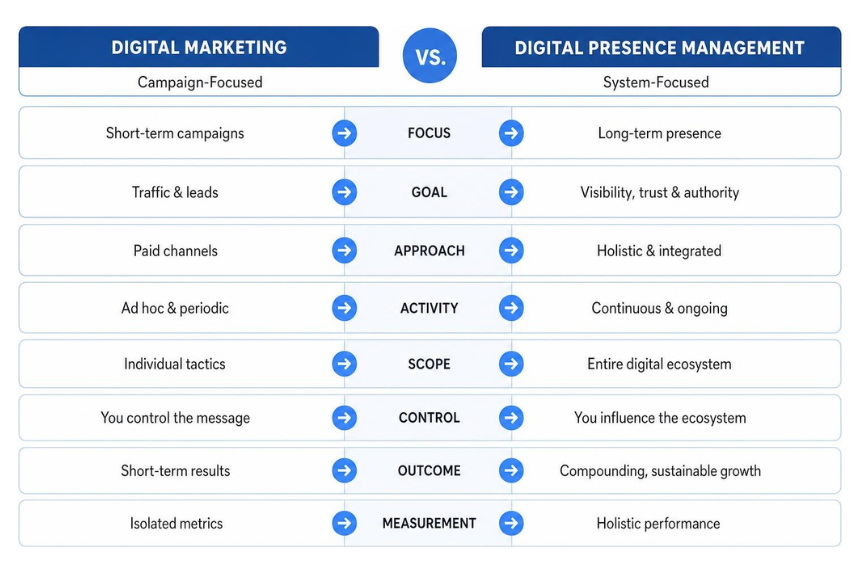
To illustrate the difference between traditional, campaign-based digital marketing and the continuous, system-focused approach of digital presence management, consider the following:
The Core Pillars of a Resilient Digital Presence
Building a resilient digital presence in 2026 requires a multi-faceted approach, integrating several key pillars that work in concert. These pillars are not standalone tactics but interconnected components of a comprehensive strategy aimed at maximizing visibility, engagement, and credibility.
Search Engine Optimization in the Era of AI Search
Search Engine Optimization (SEO) remains foundational, but its scope has broadened significantly. In the era of AI search, SEO is less about keyword stuffing and more about demonstrating genuine expertise and authority. This involves optimizing for Generative Engine Optimization (GEO), where content is structured to be easily understood and synthesized by AI systems providing direct answers. Implementing schema markup—structured data that helps search engines understand the context and meaning of your content—is crucial for this.
Technical SEO, ensuring your website is fast, secure, and mobile-friendly, continues to be paramount. Local search visibility is also more important than ever, especially for service-based businesses, as 76% of consumers who search for a local business on their smartphone end up visiting within a day. For businesses in specialized sectors like home services, a targeted approach to their HVAC digital marketing presence can make all the difference in connecting with local customers.
Content Strategy as the Proof of Brand Existence
Content is the lifeblood of your digital presence. It’s how you communicate your value, educate your audience, and establish your brand as a thought leader. In 2026, content must be strategic, forming interconnected topic clusters that demonstrate deep expertise rather than just individual blog posts. Businesses that publish blogs four times a week get 3.5 times more traffic and 4.5 times more leads than those blogging only once a week.
Beyond text, video content is increasingly dominant, with social video generating 1200% more shares than text and image combined. Viewers retain 95% of a message when they watch it in a video, compared to 10% when reading text. User-generated content (UGC) also plays a powerful role, as marketing campaigns with UGC result in 29% higher conversions. Your content strategy should prioritize creating valuable, shareable, and diverse content that resonates with your target audience and signals expertise to AI search systems.
Social Media and Email as Active Relationship Anchors
Social media and email marketing are critical for fostering direct relationships with your audience. Social media platforms are where conversations happen, brand stories are shared, and communities are built. However, it’s essential to be strategic about platform selection, focusing on where your target audience is most active. It’s better to have a strong, engaged presence on a few key platforms than a diluted presence across many. 91% of consumers will visit a brand’s website after following it on social media, and 89% will buy from the brand.
Email marketing remains one of the most powerful direct communication channels. With 99% of email users checking their inbox daily, it serves as a direct line to your audience, allowing for personalized messaging, exclusive offers, and relationship nurturing. Building and segmenting your email list ensures that you’re delivering relevant content to the right people, transforming subscribers into loyal brand advocates.
Navigating the Challenges of Modern Presence Management
Even with a clear understanding of the pillars, managing a robust digital presence presents significant challenges. Many businesses, particularly small to medium-sized enterprises, operate with lean marketing teams, often relying on a single individual to manage a vast array of tasks. This creates execution bandwidth problems and can lead to inconsistencies and missed opportunities.
The Reality of the Understaffed Marketing Department
The “one-person marketing department” is a common reality for many organizations. This individual is frequently expected to handle SEO, content creation, social media management, email campaigns, website updates, analytics, reporting, and now, AI-driven tasks. This immense cognitive load often leads to task fragmentation, where efforts are spread too thin, preventing deep focus on any single area. The result can be a digital presence that exists but fails to thrive, lacking the consistency and strategic depth needed to stand out.
Resource constraints, both in terms of human capital and budget, further exacerbate these issues. Without dedicated specialists for each area, maintaining brand consistency across all channels becomes a monumental task. Workflow bottlenecks emerge as the single marketer struggles to keep up with the continuous demands of a dynamic digital landscape. This highlights the urgent need for systems and tools that can amplify the efforts of limited teams.
Scaling Visibility Through Automation and AI Orchestration
To overcome these challenges, businesses are increasingly turning to automation and AI orchestration. These technologies don’t replace human marketers but empower them to achieve more with less. AI tools can assist with content creation, keyword research, social media scheduling, email segmentation, and even initial responses to customer inquiries. Automation can ensure consistent posting schedules, prompt follow-ups, and regular website maintenance checks.
The goal is to build an “operating system” for your digital presence, where various tools and processes are integrated and work together seamlessly. This approach, often championed by experts in digital strategy like Chris Robino digital presence, emphasizes workflow engineering and low-code development to create self-maintaining automated systems. By leveraging AI agents and copilots embedded directly into workflows, businesses can ensure continuity, reduce manual effort, and scale their visibility without burning out their marketing teams. This allows marketers to focus on strategy, creativity, and high-level engagement rather than repetitive, time-consuming tasks.
Protecting and Measuring Your Digital Footprint
A strong digital presence is not just about building visibility; it’s also about safeguarding your brand’s reputation and understanding the impact of your efforts. In 2026, proactive reputation management and sophisticated analytics are non-negotiable components of a successful digital strategy.
Proactive Reputation Management and Review Strategies
Your online reputation is a fragile yet powerful asset. It’s shaped by everything from online reviews and social media mentions to news articles and forum discussions. Consumers rely heavily on peer feedback, and 80% will lose trust in local businesses if they see incorrect or inconsistent information online. A proactive reputation management strategy involves actively monitoring these conversations, responding thoughtfully to reviews (both positive and negative), and ensuring consistent information across all online listings.
This goes beyond just responding to customer feedback; it involves cultivating a positive brand narrative and mitigating potential crises before they escalate. Tools and services that help Defend Digital Presence are becoming increasingly vital for businesses looking to protect their brand from misinformation or unwarranted attacks. By engaging with your audience, addressing concerns transparently, and consistently showcasing positive experiences, you build a foundation of trust that is resilient to challenges.
Analytics as the Nervous System of Digital Presence
Measuring the success and ROI of your digital presence efforts is crucial for continuous improvement. Analytics serve as the “nervous system,” providing critical insights into what’s working, what’s not, and where to allocate resources. Key performance indicators (KPIs) can include organic traffic, conversion rates, engagement metrics on social media, email open and click-through rates, and review sentiment.
By continuously tracking these metrics, businesses can make data-driven adjustments to their strategies. This involves A/B testing different content types, optimizing website conversion funnels, and refining targeting for paid campaigns. Understanding user behavior, identifying popular content, and pinpointing areas of friction allows for iterative improvements that enhance the overall digital experience and drive tangible business outcomes.
Frequently Asked Questions about Digital Presence
Here, we address some common inquiries to further clarify the nuances of building and maintaining a powerful digital presence in the current landscape.
How does digital presence differ from digital marketing?
While often used interchangeably, digital presence and digital marketing are distinct. Digital marketing is typically campaign-based, focused on specific channels (like a social media campaign or a PPC ad run), and aims for short-term wins or specific conversion goals. It asks, “How do we get attention?”
Digital presence, on the other hand, is continuous, system-focused, and aims for long-term, compounding visibility, credibility, and trust. It’s about how your business exists, performs, and is perceived across the entire digital world, at all times. It asks, “How do we remain visible, trusted, and active at all times—without burnout?” Digital marketing can be a part of building a digital presence, but digital presence is the overarching, always-on strategy.
How has AI changed how businesses build online visibility?
AI has fundamentally transformed online visibility. AI search engines no longer just rank individual web pages based on keywords; they synthesize information from diverse, trusted sources to provide direct answers, often without users needing to click through to a website. This means businesses must optimize for Generative Engine Optimization (GEO), ensuring their content is structured, authoritative, and easily digestible by AI systems.
AI also plays a role in content creation, personalization, and automation. Businesses are leveraging AI tools for faster content generation, more precise audience targeting, and automated responses. Building entity authority—where AI recognizes your brand as a credible source on specific topics—through consistent, high-quality content and structured data (like schema markup) is now paramount for appearing in AI-generated search results and answers.
What are the most critical metrics for measuring digital presence success?
Measuring digital presence success requires looking beyond vanity metrics. Critical metrics include:
- Organic Traffic & Search Visibility: Not just overall traffic, but how often your brand appears in search results (impressions) and the quality of that traffic.
- Conversion Rates: The percentage of visitors who complete a desired action (e.g., purchase, form submission, call). This directly ties to ROI.
- Brand Mentions & Sentiment: How often your brand is mentioned across the web (social media, news, forums) and the overall tone (positive, neutral, negative).
- Online Review Ratings & Volume: The average star rating and the number of reviews on platforms like Google Business Profile, Yelp, and industry-specific sites.
- Engagement Rates: On social media (likes, shares, comments) and email (open rates, click-through rates), indicating how well your content resonates.
- Website Performance: Core Web Vitals, page speed, mobile-friendliness, and bounce rate, as these impact user experience and search rankings.
These metrics, when analyzed collectively, provide a holistic view of your digital presence’s health and effectiveness.
Conclusion
In the rapidly evolving digital landscape of 2026, establishing a strong digital presence is no longer optional—it’s a fundamental requirement for business survival and growth. It demands a strategic, continuous, and integrated approach that moves beyond simple online existence. By focusing on the core pillars of modern SEO, strategic content creation, active social media and email engagement, and proactive reputation management, businesses can build a resilient online footprint.
Navigating challenges like limited resources and understaffed marketing teams can be overcome through the intelligent application of automation and AI orchestration, empowering teams to scale their efforts effectively. A robust digital presence is about more than just visibility; it’s about building lasting credibility, fostering audience trust, and driving measurable business outcomes. Through consistent execution and a commitment to adapting to new technologies and buyer behaviors, your business can not only exist online but truly flourish, securing its place in the competitive digital future.