
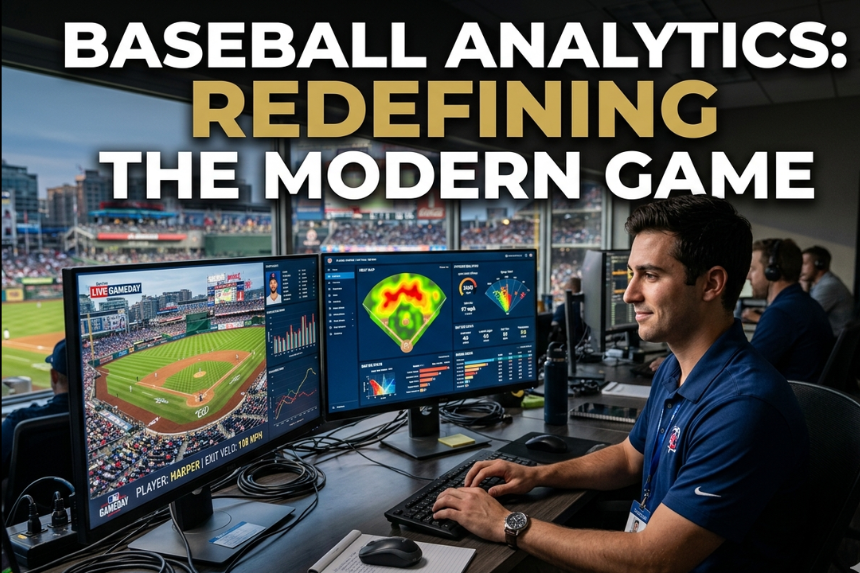
Baseball has always been a game of patterns. Some visible, some hidden. For decades, managers leaned on experience, instinct, and what “felt right” in the moment. That approach worked often enough to build traditions and legends. But over time, something changed. Numbers started speaking louder than intuition.
Today, baseball is no longer just guided by gut decisions. It is shaped, tested, and often defined by data science. Every pitch, swing, and defensive shift can be measured. And those measurements now influence how teams win or lose.
This shift did not happen overnight. It was gradual. Quiet at first. Then unavoidable.
The Era of Gut Decisions
There was a long stretch in baseball history when decision-making was largely personal. Managers trusted what they saw and what they believed about players. If a pitcher “looked strong,” he stayed in the game. If a hitter had a “good feel” at the plate, he might get more at-bats despite a small sample of recent results.
These decisions were shaped by experience. And experience matters. But it also comes with bias.
A player who looked confident might get more opportunities than one who simply performed better in less visible ways. Scouts often emphasized tools like arm strength or swing style rather than outcomes over time. The game was rich with observation, but limited in measurement.
That limitation created blind spots. Teams did not always know why something worked. They only knew that it did.
Data Enters the Clubhouse
The turning point came when teams began collecting and organizing detailed game data. At first, it was simple: hits, runs, errors, and basic averages. Then it expanded. Exit velocity. Launch angle. Spin rate. Defensive range metrics.
Suddenly, baseball was no longer just a visual game. It was a measurable system.
Front offices hired analysts. Computers became as important as scouting reports. Coaches began to receive reports that challenged long-held beliefs. A batter who looked inconsistent might actually have strong underlying metrics. A pitcher with a high ERA might still be dominant in terms of strikeout quality and pitch movement.
As this shift accelerated, decision-making changed. Managers were no longer just leaders of instinct. They became interpreters of data.
Even broadcast conversations changed. Viewers started hearing terms like “expected batting average” and “wins above replacement.” The language of baseball expanded.
As Fangraphs often highlights in its analytical breakdowns, modern baseball evaluation increasingly depends on advanced metrics that reveal performance beyond traditional box scores. That perspective has become central to understanding today’s game.
Analytics in Pitching, Hitting, and Defense
Nowhere is the impact of analytics clearer than in player performance.
Pitching: Precision over Power Alone
Pitchers are no longer evaluated just on wins and losses. Instead, teams examine spin rate, pitch sequencing, release angle, and movement profiles.
A fastball is no longer just “fast.” It is tracked for vertical break and how it plays off other pitches. A slider is not just a breaking ball. It is studied for deception and consistency across counts.
This has changed how pitchers train. Many now adjust grips, arm angles, and pitch mixes based on data feedback rather than tradition.
The result is a more specialized style of pitching. Fewer pitchers try to do everything. More focus on maximizing a few elite traits.
Hitting: Beyond Batting Average
Hitting has undergone a similar transformation. Batting average once ruled everything. Now it is just one piece of a larger picture.
Teams look at launch angle consistency, hard-hit percentage, and swing decisions outside the strike zone. A hitter who strikes out often may still be valuable if his contact produces extra-base hits at a high rate.
This shift has also influenced swing mechanics. Many hitters now aim for optimized trajectories rather than simple contact. The goal is not just to hit the ball. It is to hit it in the most productive way possible.
That is why home runs have increased in many eras of modern baseball. Players are trained to lift the ball with intent, not by accident.
Defense: Positioning Becomes Strategy
Defense is where analytics quietly revolutionized the game.
Shifts, positioning charts, and spray data now dictate where players stand before the pitch is thrown. A ground ball that used to sneak through the infield might now be an easy out because a second baseman is standing exactly where the data predicts the ball will go.
Range metrics and reaction times also help teams evaluate defenders more accurately. A flashy diving catch is not always as valuable as consistent positioning that prevents hits from happening in the first place.
In many ways, defense has become a chess match. The pieces move before the ball is even in play.
The Front Office Revolution
Perhaps the biggest change has happened off the field.
Front offices now operate like analytical departments. Decisions about trades, contracts, and roster construction rely heavily on modeling and projections.
Scouts still matter. Coaches still matter. But data analysts now sit alongside them as equal voices.
This blend of human judgment and statistical modeling has reshaped team building. A player undervalued by traditional scouting may become a key acquisition if the numbers suggest hidden value. Likewise, a popular veteran might be passed over if projections show decline.
For fans looking to explore how data intersects with predictions and performance trends, https://www.docsports.com/free-picks/baseball/ offers insight into how statistical thinking extends beyond the field and into forecasting and analysis.
The balance of power in baseball organizations has shifted. Decisions are no longer made in isolation. They are tested against models, simulations, and probabilities.
A Game Still Played by Humans
Despite all the data, baseball remains human at its core. A spreadsheet cannot feel pressure. A model cannot sense momentum in a stadium. And no algorithm can fully capture timing, confidence, or leadership.
That is why the best teams do not replace intuition with data. They combine them.
Managers still make gut calls. But now those calls are often informed by thousands of data points behind the scenes. A pitcher may be pulled not because he looks tired, but because his velocity drop matches a known fatigue pattern. A batter may be shifted in the lineup based on matchup probabilities rather than simple averages.
The game is still unpredictable. That has not changed. But the tools used to understand that unpredictability have become far more advanced.
Conclusion: A New Baseball Language
Baseball has entered an era where numbers and narratives coexist. The story of each game is still told through moments—home runs, strikeouts, and defensive gems. But behind those moments is a deep structure of data shaping every decision.
What was once guided mostly by instinct is now guided by evidence. And what was once invisible is now measurable.
The result is not the loss of baseball tradition. It is its evolution.
The game has not stopped being human. It has simply learned how to understand itself more precisely.