
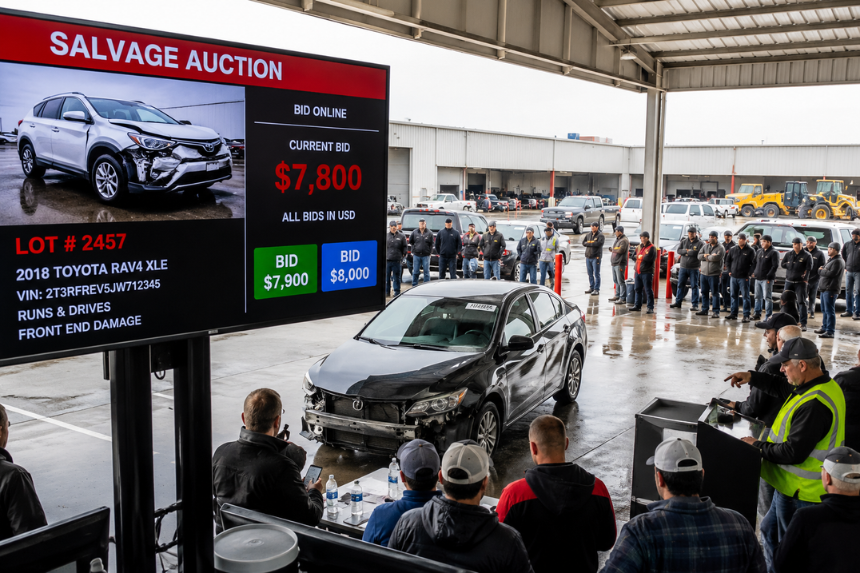
Anyone who bought salvage vehicles five years ago and is active in the market today has noticed that the pricing environment has changed. What felt like straightforward value plays in 2019 or 2020 often requires more analysis and more discipline now. Understanding what drove those price changes, and which factors are likely to persist, helps current and prospective buyers calibrate their expectations and strategies.
The Pre-Pandemic Baseline
Before 2020, the salvage auction market operated in a relatively stable pricing environment. Clean vehicle prices were predictable, the relationship between clean retail and salvage auction prices was reasonably consistent, and experienced buyers could apply established rules of thumb with reasonable confidence.
The used vehicle market was healthy but not overheated. Rental car fleets were large, new vehicle production was stable, and buyers had choices. Salvage vehicles competed in an environment where clean alternatives were readily available, which kept a ceiling on how aggressively buyers bid on damaged inventory.
Bank-seized cars from that period were priced in a market where lenders could liquidate inventory efficiently, with steady buyer demand rather than frenzied bidding.
Auction buyers during this period often relied on simplified formulas. Many rebuilders worked backward from expected clean-title resale value, subtracting estimated repair costs and a profit margin, then bidding accordingly. While experienced buyers always performed careful inspections, the market itself was stable enough that historical pricing patterns remained relatively dependable.
Transportation costs were also lower and more predictable before 2020. Shipping a vehicle across several states was far less expensive than it became during the supply chain disruptions that followed. That lower transport cost widened the pool of economically viable vehicle buyers.
The Pandemic Disruption
The COVID-19 pandemic disrupted the vehicle market, with direct and lasting effects on salvage pricing. New vehicle production slowed dramatically due to semiconductor shortages, which reduced the supply of new vehicles reaching dealerships. Rental car companies, which had sold off large portions of their fleets in 2020, were unable to replenish quickly. The used vehicle market tightened severely.
Clean used-vehicle prices rose sharply, in some cases exceeding the new-vehicle MSRP for popular models. That increase flowed directly into salvage and rebuilt vehicle prices because those prices are anchored to clean vehicle values. A vehicle worth $40,000 clean attracts higher auction bids than the same vehicle worth $25,000 clean.
Credit union repossessed cars for sale during this period, sometimes sold at prices that would have seemed unreasonable before 2020. Buyers paid more because the clean alternatives that would previously have competed were unavailable or comparably expensive.
The pandemic period also changed buyer behavior psychologically. Many consumers became willing to compromise on vehicle condition, title status, mileage, or cosmetic quality simply because inventory shortages left them with fewer alternatives. Salvage vehicles that might previously have been considered niche rebuild projects suddenly became mainstream purchasing options for cost-conscious buyers.
At the same time, stimulus payments, low interest rates, and increased online auction participation introduced more inexperienced bidders into the market. Online-only bidding environments made it easier for first-time buyers to participate aggressively without fully understanding repair costs or auction dynamics.
Supply Chain Problems and Repair Cost Inflation
The rise in salvage auction prices was not driven solely by vehicle scarcity. Repair economics changed significantly as well.
Parts shortages became common during the pandemic years. OEM components that previously arrived within days sometimes required months of waiting. Body shops faced labor shortages, shipping delays, and rising material costs. These issues increased the total cost of rebuilding damaged vehicles.
Paradoxically, those higher repair costs sometimes pushed insurers to total vehicles that would previously have been repaired conventionally. A moderate collision became economically impractical once parts delays and labor inflation were factored in. That increased the flow of repairable vehicles into salvage channels.
At the same time, rebuilders faced tighter margins because repair expenses rose alongside acquisition costs. Winning a vehicle cheaply is no longer guaranteed to be profitable if replacement parts are difficult to source or labor costs exceed projections.
Vehicles with easily available aftermarket parts became particularly desirable during this period. Domestic trucks and popular Japanese models often retained stronger bidding activity because buyers had more confidence in sourcing affordable repair components quickly.
The Growth of Online Auction Participation
Another major shift over the last five years has been the expansion of online bidding participation. Salvage auctions increasingly transitioned toward digital-first operations, allowing buyers from across the country and internationally to compete for the same inventory.
That broader buyer pool substantially increased competition. Vehicles that once attracted mostly local rebuilders could now receive bids from exporters, dismantlers, dealerships, fleet operators, and retail consumers simultaneously.
Repo auctions during this period became especially competitive for clean-condition repossessions because many buyers viewed them as lower-risk alternatives to collision-damaged inventory. Online accessibility amplified that demand.
The transparency of digital auctions also changed pricing behavior. Buyers gained easier access to historical sale data, vehicle history reports, and market pricing tools. While that improved overall market efficiency, it also reduced opportunities for inexperienced sellers to undervalue desirable inventory.
The Normalization That Followed
By 2023 and into 2024, clean vehicle prices began moderating as new production recovered and buyer urgency eased. Salvage auction prices followed, though with a lag. Some categories normalized faster than others. Sedans and compact cars returned to more typical valuation relationships relatively quickly. Trucks and SUVs remained elevated longer due to persistent buyer demand for those categories.
Repo auctions during the normalization period showed interesting patterns. Repossession volumes increased as buyers who had stretched to purchase vehicles at peak prices found themselves underwater, and some lenders began liquidating defaulted loans more aggressively.
Higher repossession volumes generally benefit auction buyers by increasing supply, which moderates prices. That effect was partially offset by continued strong demand for trucks and SUVs, which kept competitive bidding strong even as overall inventory grew.
Luxury vehicle pricing was also normalized unevenly. Premium European vehicles often experienced sharper value corrections because high financing costs reduced consumer demand for expensive used vehicles. Meanwhile, affordable commuter cars retained relatively strong pricing because inflation and economic uncertainty increased demand for budget transportation.
Electric vehicles introduced another layer of complexity. EV depreciation accelerated rapidly in some segments due to battery concerns, evolving technology, and shifting manufacturer pricing strategies. Salvage EV auctions became harder to price consistently because battery replacement costs can vary widely depending on the extent of damage.
Higher Interest Rates and Buyer Behavior
Interest rates now play a much larger role in salvage auction dynamics than they did during the ultra-low-rate period of 2020 and 2021.
Higher financing costs reduce the purchasing power of both retail buyers and dealerships. When monthly payments rise, buyers become more price-sensitive and less willing to overpay for repaired salvage vehicles.
That pressure indirectly affects salvage auction pricing because rebuilders must account for weaker resale demand when calculating maximum bid prices. Vehicles that appeared profitable during the peak-price environment may no longer leave sufficient margin after repair, transport, financing, and holding costs are included.
Commercial buyers and exporters have also become more selective. Businesses operating fleet vehicles increasingly focus on total lifecycle costs rather than simply acquiring inventory quickly. Export demand fluctuates more aggressively in response to exchange rates, overseas regulations, and global shipping costs.
Where Prices Stand Now and What to Watch
The current salvage auction market reflects a combination of factors: normalizing clean vehicle prices, higher interest rates that affect financing costs for buyers who use leverage, increased repossession volumes, and persistent demand for specific vehicle categories.
Popular trucks and SUVs in repairable condition continue to attract competitive bidding. Sedans and less popular models are more reasonably priced relative to their repair potential. Flood-damaged vehicles remain difficult to price accurately because the extent of damage varies, and buyer confidence is lower after high-profile flood events that led to widespread hidden damage claims.
Hybrid vehicles and fuel-efficient commuter cars may continue strengthening if fuel prices rise significantly again. Conversely, large luxury SUVs and specialty performance vehicles remain more vulnerable to economic slowdowns because they depend heavily on discretionary consumer spending.
Insurance practices will likely continue influencing future salvage supply. As vehicles become more technologically complex, insurers may total newer vehicles more often because sensor calibration, battery systems, and advanced safety equipment make repairs more expensive.
The Long-Term Lesson for Buyers
The most reliable approach in the current environment is the same as it has always been: accurate damage assessment, conservative cost estimation, and discipline on bid price. Market conditions affect the absolute price levels, but do not change the fundamental logic of buying well.
Experienced buyers adapt to changing market conditions instead of relying on outdated assumptions from previous pricing cycles. The rebuilders and dealers who remain consistently profitable are typically those who understand margins precisely, avoid emotional bidding, and adjust their strategies as market conditions evolve.
Ultimately, the last five years demonstrated that salvage auctions are closely tied to broader economic conditions, supply chains, credit markets, and consumer behavior. Buyers who understand those larger market forces gain a significant advantage because they can recognize whether rising prices reflect genuine long-term value or temporary market distortion.