Most founders don’t lose investor interest because of a bad product—they lose it because of how they present information. According to a report by DocSend, investors spend an average of just a few minutes reviewing startup materials before deciding whether to engage further. That means your setup matters more than you think.
Many founders default to Google Drive because it’s familiar, fast, and free. But here’s the problem: what works for internal collaboration often fails under investor scrutiny. A poorly structured system creates friction, slows due diligence, and quietly signals a lack of readiness.
If you’re using, or considering using-Google Drive instead of proper investor data rooms, this guide will show you where that decision breaks down. We’ll compare both options in real scenarios, explain what founders consistently get wrong, and help you choose the right approach depending on your stage and goals.
Why Investor Data Rooms Exist in the First Place
The idea behind investor data rooms is not storage, it’s controlled transparency.
In a live deal, whether it’s fundraising, M&A, or strategic partnerships, you’re sharing sensitive information with multiple external parties. These include investors, lawyers, advisors, and sometimes competitors. The challenge is not just access, but precision: who sees what, when, and under what conditions.
Google Drive was never designed for this environment. It’s built for collaboration, not controlled disclosure. That distinction becomes critical once real money is involved.
Deloitte notes that structured virtual data rooms improve deal efficiency and reduce risk exposure during due diligence. The difference comes from control, auditability, and clarity, none of which are native strengths of general-purpose cloud storage.
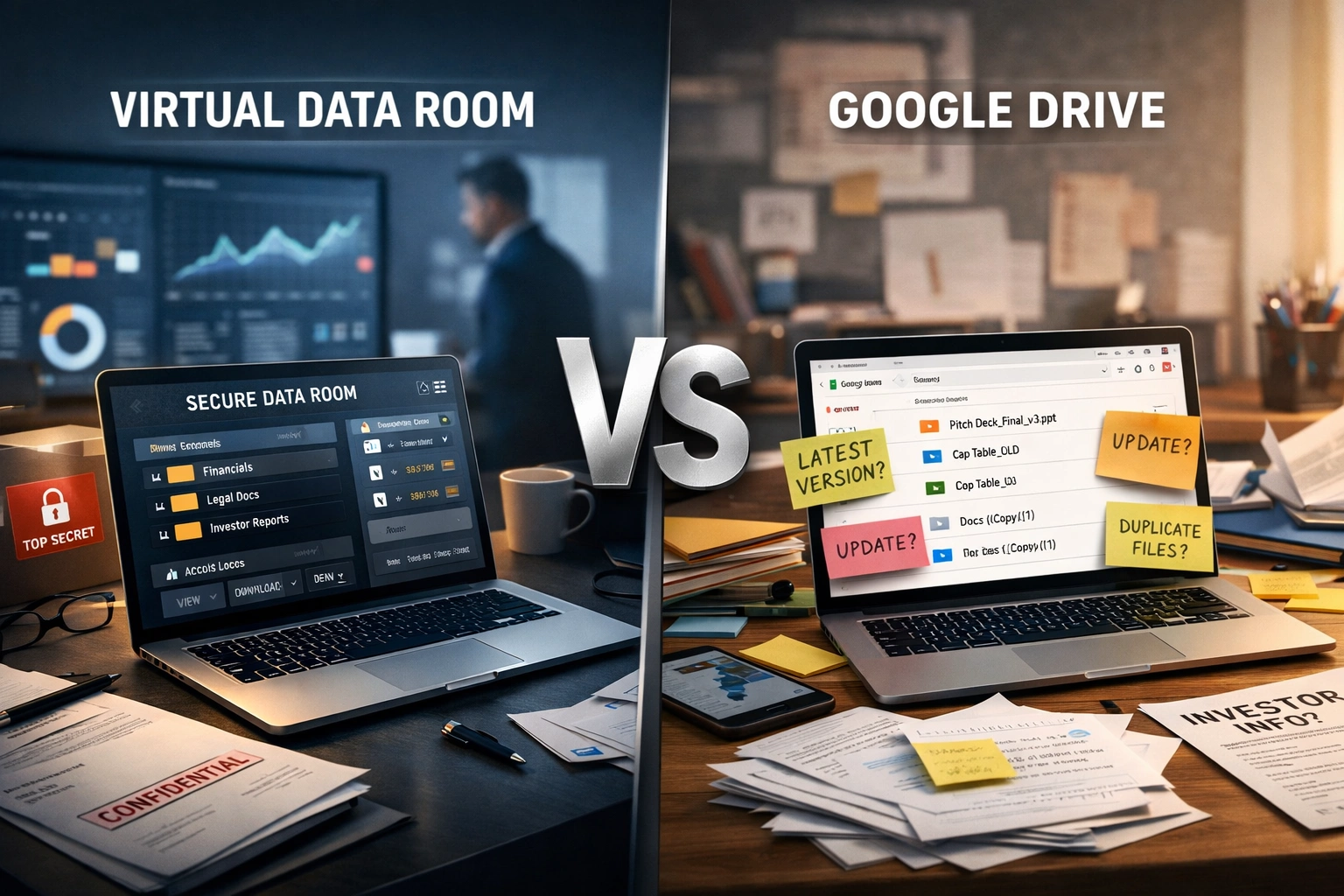
Virtual Data Room vs Google Drive: Core Differences
The real gap between these tools only becomes obvious during active fundraising or due diligence. What looks similar at the start creates very different outcomes under pressure.
| Feature | Virtual Data Room (Investor Data Rooms) | Google Drive |
| Purpose | Built for transactions & due diligence | Built for collaboration |
| Permission control | Granular (file, folder, user level) | Basic (view/edit access) |
| Audit trail | Full tracking of user activity | Limited visibility |
| Investor analytics | Detailed (views, time spent, engagement) | Minimal or none |
| Document protection | Watermarks, restricted downloads | Limited protection |
| Q&A workflow | Built-in structured communication | Not available |
| Scalability | Designed for large, complex deals | Becomes messy at scale |
| Compliance readiness | High (ISO, SOC 2, GDPR support) | Not deal-focused |
| User experience for investors | Structured, guided navigation | Depends on folder setup |
| Perception by investors | Professional, deal-ready | Informal, early-stage |
The difference isn’t technical, it’s contextual. Investor data rooms are designed for decision-making environments. Google Drive is not.
What Founders Get Wrong About Google Drive
Mistaking Familiarity for Readiness
The most common mistake is assuming that because Google Drive is easy for you, it will be easy for investors.
It won’t.
Investors review dozens of companies at once. They expect a consistent, structured environment. When they open a messy folder hierarchy or encounter unclear naming conventions, they don’t try to figure it out—they move on faster.
Using proper investor data rooms eliminates this issue by aligning your presentation with investor expectations.
Underestimating the Importance of Control
In early conversations, broad access might seem harmless. But as discussions progress, control becomes critical.
Google Drive offers basic permission settings, but they lack nuance. You cannot easily restrict access at a highly granular level while maintaining a clean structure. You also cannot fully prevent downloading or track detailed user activity in a meaningful way.
In contrast, investor data rooms allow you to control visibility down to individual documents, apply dynamic watermarks, and monitor exactly how users interact with your data.
That level of control is not optional in serious transactions, it’s expected.
Ignoring Investor Behavior and Analytics
One of the biggest hidden advantages of investor data rooms is visibility.
You can see which documents investors open, how long they spend on them, and what they revisit. This insight allows you to understand interest levels and tailor your follow-ups.
Google Drive provides almost none of this.
According to PwC, data-driven decision-making is increasingly central to deal execution. Without analytics, you’re operating blindly.
When Google Drive Still Makes Sense
It would be a mistake to say Google Drive has no place in fundraising.
At very early stages-pre-seed or informal conversations-it can work as a lightweight solution. If you’re sharing a pitch deck, a simple financial model, or early materials, speed may matter more than structure.
However, this only holds true for initial interactions. Once due diligence begins, expectations change.
Think of it this way: Google Drive can help you start conversations, but it rarely helps you close them.
When You Need Investor Data Rooms
As soon as your process becomes structured, you need a structured tool.
This typically happens when:
- You are engaging multiple investors simultaneously
- Due diligence materials expand beyond basic documents
- Legal or financial advisors become involved
- You need to control access in phases
- You want visibility into investor engagement
At this point, continuing with Google Drive introduces unnecessary risk and inefficiency.
Investor data rooms are built precisely for this transition-from informal sharing to formal evaluation.
Real-World Example: Where Google Drive Breaks Down
A startup raising a Series A initially used Google Drive to manage investor materials. Early conversations went smoothly, but problems emerged once multiple investors entered due diligence.
Documents were duplicated, access permissions became inconsistent, and investors began requesting clarification on file versions. The team spent more time managing the system than focusing on the deal.
After switching to a virtual data room, the structure became standardized, access was controlled, and communication improved. The fundraising process regained momentum.
The key takeaway is simple: the tool didn’t change the business-but it changed how the business was perceived.
The Hidden Cost of Choosing the Wrong Tool
Founders often choose Google Drive to save money. But the real cost is not financial-it’s strategic.
A disorganized or poorly controlled environment creates doubt. Investors may question your operational discipline, your attention to detail, or your ability to manage complexity.
Bain & Company highlights that transparency and execution quality are major factors in investment decisions. Your data room is one of the clearest signals of both.
Using proper investor data rooms strengthens that signal. Using the wrong tool weakens it.
Final Thoughts
The choice between Google Drive and a virtual data room is not about features-it’s about context.
Google Drive is fast, familiar, and useful at the very beginning. But it was never designed for structured transactions.
Investor data rooms, on the other hand, are built for exactly that purpose. They support control, clarity, and credibility when it matters most.
If you’re serious about raising capital or running a deal, the question is not whether you can use Google Drive.
It’s whether you should.