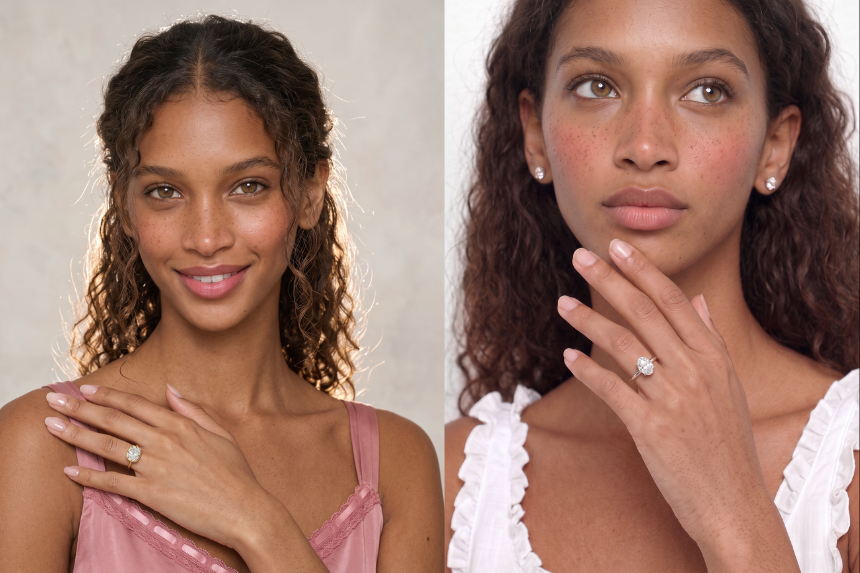
One cushion-cut ring looks almost square, with full, rounded edges. Another looks longer and slimmer. A third seems more angular once it is set in metal. All three can appear under the same shopping filter.
That variety is part of the appeal, but it can make a saved collection of ring photographs confusing. The shape name gives you a starting point. The outline of the particular stone, its reflections and the surrounding setting explain much more about the finished ring.
Look at the Corners and Sides
Cushion-cut diamonds commonly have a square or rectangular outline with softened corners. GIA’s cushion-cut guide describes considerable variation in both proportions and facet arrangements, so two cushions need not have the same character.
Lily Arkwright’s collection of soft-cornered cushion designs includes diamonds, moissanite and coloured gemstones in different settings. Select the same gemstone material for your comparison, then follow the centre’s edge. Notice how much the sides bow out and how gradually they turn into the corners.
Fuller curves can give an outline a plumper appearance. Straighter sides with smaller corner curves can look more structured. That difference may explain a preference that “square cushion” alone does not capture.
Check What “Elongated” Adds
Lily Arkwright’s separate ring collection shows elongated cushion proportions in solitaires and more decorated settings. Its platinum Florence solitaire holds a lab-grown diamond in a four-prong setting, giving a clear example of the longer outline.
An elongated cushion belongs to the same shape family, with more length relative to its width. That description does not specify a single outline: the sides can still curve differently, and the corners can be fuller or tighter.
For outline comparisons, use similar straight-on photographs and check the pictured stone size. The Florence page labels its product and model photographs as showing a 2ct diamond, which may differ from the option selected in the menu.
Put Weight and Dimensions Beside Each Other
Length divided by width gives the stone’s length-to-width ratio. For illustration, outlines measuring 8 × 6mm and 10 × 7.5mm both have a ratio of approximately 1.33, despite their different dimensions. The ratio describes how stretched the outline is; the millimetre measurements tell you its size.
Carat measures a diamond’s weight, rather than its visible length and width. Record those dimensions alongside the carat figure when comparing shortlisted stones. A longer cushion may occupy more space along the finger while being narrower across it.
Also check whether a quoted weight describes the centre alone or includes surrounding diamonds. A ring’s total diamond weight cannot tell you the dimensions of its main stone. For a decorated setting, ask for the complete ring’s top-view measurements as well.
Separate the Centre From Its Frame
A halo adds a border of small stones around the centre, changing the complete ring’s outline. A full bezel surrounds the stone with a metal rim. Claws leave more breaks around the edge, although their shape and position still contribute to what you see.
Ask yourself which edge you liked in the photograph. Was it the cushion itself, the diamond border or the shape made by the metal? Someone drawn to a broad, rounded halo may discover that a plain solitaire with a similar centre feels quite different.
Orientation matters too. An east-west setting places an elongated stone across the finger. If one photograph shows the ring that way and another shows it running along the finger, take account of the different direction when comparing the outlines.
Watch the Reflections Change
The cushion’s outline is only part of its appearance. Facet arrangement affects the pattern of reflections inside it. Some stones show larger, more distinct flashes; others have a busier pattern of smaller reflections. A square or elongated label cannot tell you which you will prefer.
Ask for slow videos of the actual diamonds tilting, filmed with similar angles, lighting and magnification. Watch what happens across each centre as it moves. If you can view the stones in person, compare them together in different lighting too.
Once you have tried a few, describe what you liked in ordinary words: “I prefer the more rounded corners, a slightly longer centre and a plain band.” That gives a jeweller something useful to work with. You can enjoy the cushion shape while being quite particular about your version of it.