
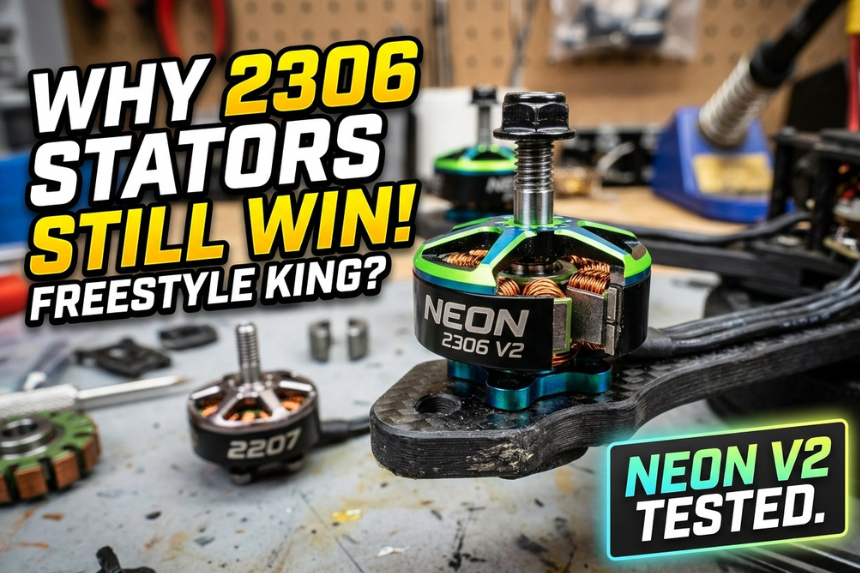
Every two years the hobby decides a stator size is obsolete. 2207 “replaced” 2306, then 2208 was going to replace 2207, and meanwhile half the podium at any freestyle event is still running a 2306 because it does the one thing that matters in freestyle: it changes direction fast.
The 2306’s advantage is geometric. A wider, shorter stator (23mm × 6mm = 3,312mm³) has more of its magnetic material at a larger radius than a 2207 (22 × 7 = 3,388mm³). Nearly identical volume, but the 2306 trades a little torque depth for faster acceleration — which is why it snaps out of a roll and picks up a tumbling quad more crisply. The MEPS Neon 2306 V2 is a good lens on whether that trade still makes sense in 2026.
The measured case
MEPS’s bench data for the 1950KV version on SZ5145 tri-blades:
| Metric | Figure |
| Thrust @ 50% throttle | 743g |
| Peak thrust | 1,821g |
| Gain over Gen 1 | +13.5% usable thrust |
| KV options | 1750 / 1950 / 2550 |
That 743g at half stick is the number to stare at. It means the motor is already doing real work at the throttle position where you actually spend 80% of a freestyle flight — not just at the top end where the peak number lives. A motor with a big peak and a weak mid-range feels like it has a hole in the throttle curve; this one doesn’t.
KV choice is the whole decision
| KV | Voltage | Fly it if |
| 1750KV | 6S | Cinematic, cruising, camera-hauling. Lowest current, longest flight time, smoothest lines. |
| 1950KV | 6S | The default. Best balance of punch, efficiency and flight time for freestyle. |
| 2550KV | 4S | 4S builds, racers, anyone who wants snappier spool-up. |
If you’re building a 5-inch to carry a GoPro or an O3 and you care more about flight time than punch-outs, 1750KV on 6S is the underrated pick here. Lower KV plus a 5145 prop is the efficiency configuration — you give up maybe 8% of top-end thrust and gain a minute of flight time and a cooler motor.
Efficiency is the real story
The V2 changes that matter aren’t the peak numbers, they’re the electromagnetic ones: an optimized winding and a better stator lamination stack. The practical translation is less heat per amp, which shows up in three places freestyle pilots notice:
- Back-to-back packs. The third battery of a session feels like the first, instead of the quad getting progressively mushier as the motors heat-soak.
- Battery sag. Lower losses mean your 6S 1,300mAh holds voltage a little deeper into the pack, so your mAh alarm isn’t screaming at 3 minutes.
- Consistency of tune. Motors that run cooler keep their magnetic strength, so your PIDs don’t drift as the session goes on.
Durability: the honest version
The V2 uses a lightweight aluminum rotor, 6082 aluminum bell, stainless shaft, N50H magnets and NMB bearings — the correct parts list. During MEPS’s own testing the motor took a crash and kept flying without a performance change, which is the realistic claim: no brushless motor is crash-proof, but the good ones survive the ordinary impacts that end a session for the cheap ones.
What I’d watch: the lightweight rotor is a deliberate mass reduction, which is good for response and slightly less forgiving than a heavy reinforced bell in a hard concrete impact. If you fly bandos every weekend, the thicker-belled 2207 V2 is the more sensible choice. If you fly parks, fields and the occasional gate clip, the 2306 V2’s lighter rotating mass is the better flying motor.
Where it fits
- 5-inch freestyle, 6S: 1950KV. This is the answer for 80% of builders.
- Cinematic 5-inch with a camera: 1750KV. Efficiency and smoothness over punch.
- 4S freestyle / racing: 2550KV.
- Props: 5-inch tri-blades, 5145–5146 range. Don’t put a 5.5-inch bi-blade on a 2550KV 4S motor and expect it to live.
- ESC: 45–55A 4-in-1 is comfortable at these current levels.
Pair it with a 6S 1,300–1,500mAh pack and a frame in the 110–125g class and you get a quad that feels light without feeling weak.
Verdict
The 2306 shape keeps earning its place because freestyle is a game of direction changes, not top speed. The Neon 2306 V2 delivers the two things that make that shape work — a strong mid-throttle and a light rotor — at a price that makes a five-motor set cheaper than two flagship motors.
It’s not the motor for a 7-inch, and it’s not the motor if your local spot is all concrete and rebar. For everything else on 5 inches, it’s the sensible default: smooth, efficient, cheap to crash.
Rating: 4.5/5.
Disclosure: review sample supplied by the manufacturer. Bench figures are the manufacturer’s published data; flight impressions are my own.