Core Property Selling Strategies Based on Fair Market Value
At the heart of any successful property sale lies a robust understanding of its fair market value. This isn’t merely an arbitrary figure; it’s a dynamic assessment influenced by a multitude of factors, from the unique characteristics of your home to the broader economic landscape. For homeowners looking to sell in September 2026, a strategic approach to valuation is paramount. It involves not only assessing your property’s intrinsic worth but also positioning it effectively within current market dynamics, inventory levels, and absorption rates to achieve your target pricing.
Comparative Market Analysis and Property Selling Strategies
One of the most foundational and widely accepted methods for determining a property’s fair market value is the Comparative Market Analysis (CMA). This strategy involves meticulously examining recent sales of similar properties, often referred to as “comparables” or “comps,” within your immediate area. The goal is to identify patterns and establish a realistic price range for your home.
When conducting a CMA, we prioritize properties that have sold within the last three to six months, ensuring the data reflects current market conditions. Geographic proximity is also crucial; ideally, comparables should be within the same neighborhood or a closely similar one, sharing similar zoning, school districts, and amenities.
Once suitable comparables are identified, a “bracketing technique” is employed. This involves finding properties that are both slightly superior and slightly inferior to yours in key aspects. This helps to establish an upper and lower bound for your property’s value. From there, “line-item adjustments” are made to account for differences between your home and each comparable. For instance, if a comparable has an extra bathroom that your property lacks, its sale price would be adjusted downwards to reflect that difference when comparing it to your home. Conversely, if your home features a newly renovated kitchen that a comparable does not, the comparable’s price might be adjusted upwards. These adjustments are typically made for factors like square footage, lot size, age, condition, number of bedrooms/bathrooms, garage capacity, and significant upgrades.
The reliability of a CMA hinges on the quality and relevance of the data. For homeowners seeking to truly master their pricing strategy, delving into data-driven pricing strategies can provide a deeper understanding of how these adjustments and market insights translate into an optimal listing price. This meticulous process ensures that the derived value is not only defensible but also highly attractive to prospective buyers.
Data-Driven Property Selling Strategies in Shifting Economic Conditions
The broader economic environment plays an undeniable role in shaping the fair market value of real estate. In September 2026, as we look at the market, consider how macroeconomic factors—such as interest rates, inflation metrics, housing supply, and buyer demand—collectively influence mortgage affordability and, consequently, property values.
Interest Rates: Fluctuations in interest rates directly impact a buyer’s purchasing power. When interest rates rise, the cost of borrowing increases, leading to higher monthly mortgage payments for the same loan amount. This can cool buyer demand, as properties become less affordable, potentially putting downward pressure on prices. Conversely, lower interest rates can stimulate demand, allowing buyers to qualify for larger loans and potentially driving up property values.
Inflation Metrics: Inflation, the rate at which prices for goods and services increase, also has a complex relationship with real estate. While real estate is often seen as a hedge against inflation, high inflation can lead to increased construction costs, which might push up the price of new homes. However, if inflation is coupled with rising interest rates and stagnant wages, it can erode consumer confidence and reduce disposable income, making homeownership less accessible.
Housing Supply and Buyer Demand: The fundamental economic principles of supply and demand are perhaps the most direct influencers of fair market value. A market with low housing inventory and high buyer demand typically sees property values appreciate. Buyers compete for limited listings, often leading to bidding wars and sales above asking price. Conversely, an oversupply of homes coupled with subdued demand can result in longer market times and price reductions. Understanding these dynamics is crucial for setting a competitive price that aligns with current market sentiment.
Mortgage Affordability: This factor synthesizes interest rates, property prices, and average income levels. When homes are affordable relative to incomes and mortgage rates are reasonable, more buyers can enter the market, sustaining demand. If affordability declines due due to high prices or high rates, the buyer pool shrinks, potentially impacting the speed of sales and the final sale price.
By watching these indicators, homeowners can strategically adjust their selling approach. For instance, in a market with rising interest rates, pricing competitively from the outset might be more effective than aiming for a top-tier price.
Valuation Approaches: Sales Comparison, Cost, and Income Methods
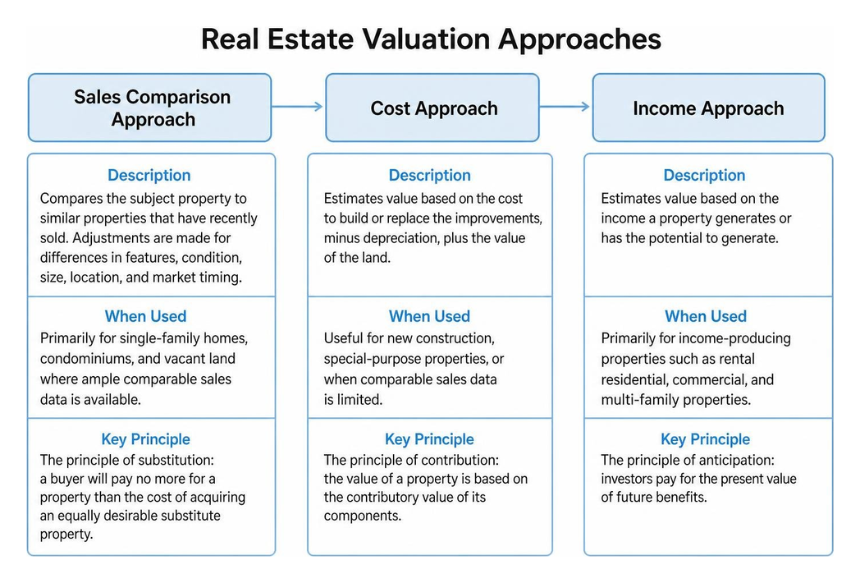
While the Comparative Market Analysis (CMA) predominantly relies on the sales comparison approach, professional appraisers often utilize a combination of three primary valuation methods to arrive at a comprehensive assessment of fair market value. These approaches offer different perspectives and are particularly useful depending on the type of property being valued.
1. Sales Comparison Approach:
- Description: This is the most common and reliable method for residential properties. It involves comparing the subject property to similar properties that have recently sold in the same market. Adjustments are made for differences in features, condition, size, location, and market timing.
- When Used: Primarily for single-family homes, condominiums, and vacant land where ample comparable sales data is available.
- Key Principle: The principle of substitution, which states that a buyer will pay no more for a property than the cost of acquiring an equally desirable substitute property.
2. Cost Approach (or Replacement Cost Approach):
- Description: This method estimates the cost to replace the property’s improvements (structures) with a new one of similar utility, minus any accumulated depreciation, plus the value of the land. Depreciation accounts for physical deterioration, functional obsolescence, and external obsolescence.
- When Used: Most effective for new construction, unique properties (like churches or schools), or properties where comparable sales are scarce. It’s also often used as a check for other valuation methods.
- Key Principle: The principle of contribution, where the value of a component is measured by how much it adds to the overall value of the property.
3. Income Capitalization Approach:
- Description: This approach is primarily used for income-producing properties (e.g., rental homes, apartment buildings, commercial properties). It converts the property’s anticipated future income stream into a present value. This is often done by dividing the property’s Net Operating Income (NOI) by a capitalization rate (Cap Rate).
- When Used: For investment properties where a buyer’s primary motivation is the income the property generates.
- Key Principle: The principle of anticipation, which states that value is created by the expectation of future benefits (income).
For residential homeowners, the sales comparison approach will almost always be the primary method used by real estate professionals and appraisers. However, understanding the other approaches provides a holistic view of how property values are determined, especially if your property has unique characteristics or income-generating potential.
Optimizing the Transaction Process for Maximum Return
Determining the fair market value is a critical first step, but optimizing the entire transaction process is equally vital for maximizing your return. From the initial listing to the final transaction settlement, every stage presents an opportunity to enhance your property’s appeal, streamline negotiations, and ensure a smooth closing. This involves meticulous preparation, understanding appraisal standards, and navigating buyer financing criteria effectively.
Reconciling Professional Appraisals and Automated Valuation Models
In the current real estate landscape of September 2026, homeowners have access to various tools for estimating property value. Two prominent methods are professional appraisals and Automated Valuation Models (AVMs). While both aim to provide a value estimate, their methodologies, accuracy, and acceptance in formal transactions differ significantly.
Here’s a list of key operational differences:
- Professional Appraisal:
- Methodology: Conducted by a state-licensed and certified appraiser who physically inspects the property, analyzes comparable sales, considers market conditions, and applies the sales comparison, cost, and/or income approaches.
- Accuracy & Reliability: Generally considered the most accurate and reliable method due to the appraiser’s on-site inspection, local market expertise, and ability to account for unique property features or deficiencies.
- Acceptance: Required by lenders for mortgage financing, accepted by courts for legal matters (e.g., divorce, estates), and by the IRS for tax purposes. Appraisers adhere to Uniform Standards of Professional Appraisal Practice (USPAP) compliance.
- Cost & Time: Involves a fee (typically several hundred dollars) and takes several days to a week to complete.
- Valuation Variance: Lower variance due to human judgment and detailed analysis.
- Automated Valuation Models (AVMs):
- Methodology: Computer-generated estimates based on algorithms that analyze public record data (e.g., past sales, property characteristics), and sometimes multiple listing service (MLS) data, without a physical inspection.
- Accuracy & Reliability: Can provide a quick estimate but their accuracy varies widely. They struggle with unique properties, rapidly changing markets, or areas with limited comparable sales. On-market homes tend to have higher accuracy than off-market properties.
- Acceptance: Not typically accepted by lenders for primary mortgage decisions, nor by courts or the IRS for formal valuations. They are best used as a starting point or for general market research.
- Cost & Time: Often free and instantaneous.
- Valuation Variance: Higher variance, especially for off-market properties or in volatile markets, due to their inability to assess condition, curb appeal, or recent unrecorded improvements.
For homeowners, understanding this distinction is crucial. While AVMs like Zestimates can offer a quick preliminary idea, a professional appraisal is the definitive standard for any transaction involving financing, legal proceedings, or significant financial decisions.
Strategic Property Preparation and Adjustment Alignments
The condition of your property is a direct determinant of its fair market value and its appeal to buyers. Strategic property preparation involves not just superficial cleaning but also addressing key areas that can influence an appraiser’s assessment and a buyer’s willingness to pay.
Property Condition: A well-maintained home with no deferred maintenance (e.g., leaky roof, outdated HVAC, peeling paint) will invariably command a higher value. Buyers are often willing to pay a premium for move-in ready homes, and appraisers will note any significant disrepair, which can lead to downward adjustments.
Capital Improvements: Thoughtful upgrades can significantly enhance value. These include renovations to kitchens and bathrooms, energy-efficient windows, updated roofing, or additions that increase usable living space. It’s important to differentiate between capital improvements (which add value) and routine maintenance (which preserves value but doesn’t necessarily increase it). Documenting all improvements with receipts and permits can be invaluable during the appraisal process.
Seller Concessions and Financing Buydowns: In a competitive market, sellers might offer concessions to incentivize buyers. These can include covering a portion of closing costs, offering repair credits, or even providing financing buydowns (paying to reduce the buyer’s interest rate for an initial period). While these can facilitate a sale, it’s important to understand how they impact the net proceeds and how appraisers might view them. Excessive seller concessions can sometimes signal that the list price was too high or that the property has underlying issues, and appraisers may adjust the comparable sales downward if concessions exceed typical market norms. For example, some guidelines suggest that seller buydowns exceeding a certain percentage (e.g., six percent) might be deducted dollar-for-dollar from a comparable’s price to reflect the true cash value.
Aligning these preparations with market expectations and potential appraisal scrutiny is key. A home that is well-prepared and strategically positioned with appropriate, not excessive, concessions will generally achieve a better outcome.
Buyer Financing Considerations and Closing Negotiations
The journey to a successful sale culminates in buyer financing and the final negotiation process. Understanding these elements is crucial for homeowners to anticipate potential hurdles and strategize effectively.
Mortgage Underwriting and Loan-to-Value Ratios: Most buyers will rely on mortgage financing. Lenders conduct rigorous underwriting to assess a buyer’s creditworthiness and the property’s value. A key metric is the loan-to-value (LTV) ratio, which compares the loan amount to the appraised value of the property. If the appraisal comes in lower than the agreed-upon purchase price, it can create an “appraisal gap.” This gap can jeopardize the sale if the buyer cannot or will not cover the difference in cash, or if the seller is unwilling to reduce the price.
Appraisal Contingencies: Purchase agreements often include an appraisal contingency, allowing the buyer to withdraw from the contract or renegotiate if the property appraises for less than the sales price. Homeowners must be prepared for this possibility and understand their options, which might include lowering the price, negotiating a split of the difference, or allowing the buyer to walk away.
Counteroffer Strategy and Concession Thresholds: Negotiations are a delicate dance. A well-informed seller will have a clear counteroffer strategy, knowing their bottom line and what concessions they are willing to make. This includes setting concession thresholds for repairs, closing costs, or other buyer requests. Overly aggressive negotiation or an unwillingness to compromise on minor issues can derail a sale, especially in a buyer’s market. Conversely, being too accommodating can leave money on the table.
Closing Reconciliation: The final stage involves the reconciliation of all financial aspects at closing. This includes ensuring all agreed-upon credits, prorated taxes, and fees are accurately accounted for. A smooth closing process is the ultimate goal, signifying a successful transaction where both parties feel the terms are fair. By understanding the intricacies of buyer financing and being prepared for negotiations, homeowners can navigate this critical phase with confidence, securing the maximum return on their investment.