
Strategic Foundations: Measuring and Analyzing Business Performance
Sustainable growth is not merely a matter of increasing sales volume; it requires a deep understanding of the variables that influence your top-line performance. Revenue growth is influenced by a complex interplay of external factors—such as shifting market demand, macroeconomic volatility, and regulatory changes—and internal levers, including pricing elasticity, operational efficiency, and the quality of your sales execution.
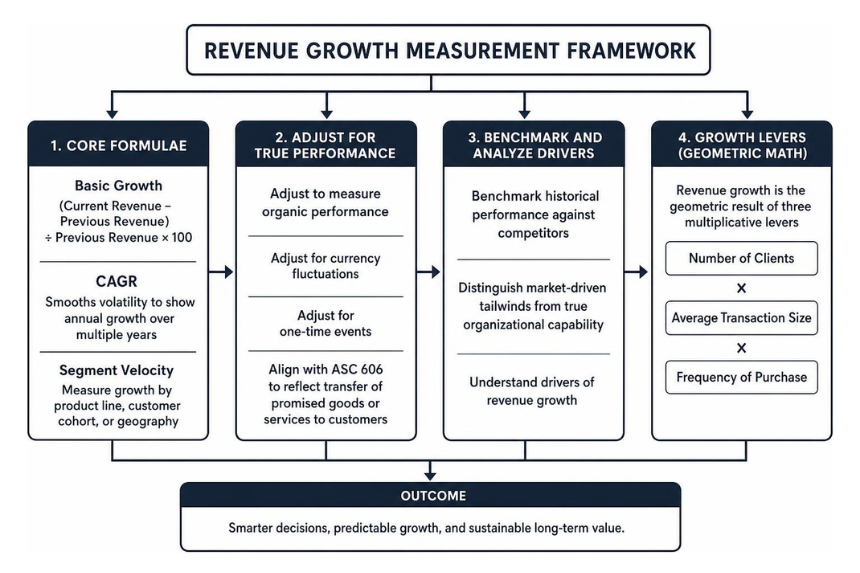
To build a predictable growth engine, leaders must first move beyond anecdotal evidence. This begins with rigorous benchmarking. By analyzing historical performance alongside competitive benchmarks, firms can distinguish between market-driven tailwinds and true organizational capability.
Core Formulae: Basic Growth, CAGR, and Segment Velocity
Measuring success starts with the basics. The most common metric is the year-over-year growth rate, calculated by taking the difference between current period revenue and previous period revenue, dividing that by the previous period revenue, and multiplying by 100. However, for companies experiencing seasonal fluctuations or those looking to understand long-term trajectory, the Compound Annual Growth Rate (CAGR) is essential. CAGR smooths out year-to-year volatility, providing a singular annual growth figure that represents how an investment or revenue stream has grown over a multi-year period.
Beyond high-level totals, segment-specific growth analysis is vital. By isolating performance by product line, customer cohort, or geography, businesses can identify which segments are driving value and which are stagnating. When performing these calculations, it is critical to adjust for currency fluctuations and one-time events to ensure you are measuring organic performance. For public companies, aligning these metrics with accounting standards like ASC 606 ensures that revenue recognition accurately reflects the transfer of promised goods or services to customers.
The Geometric Math of the Three Core Growth Levers
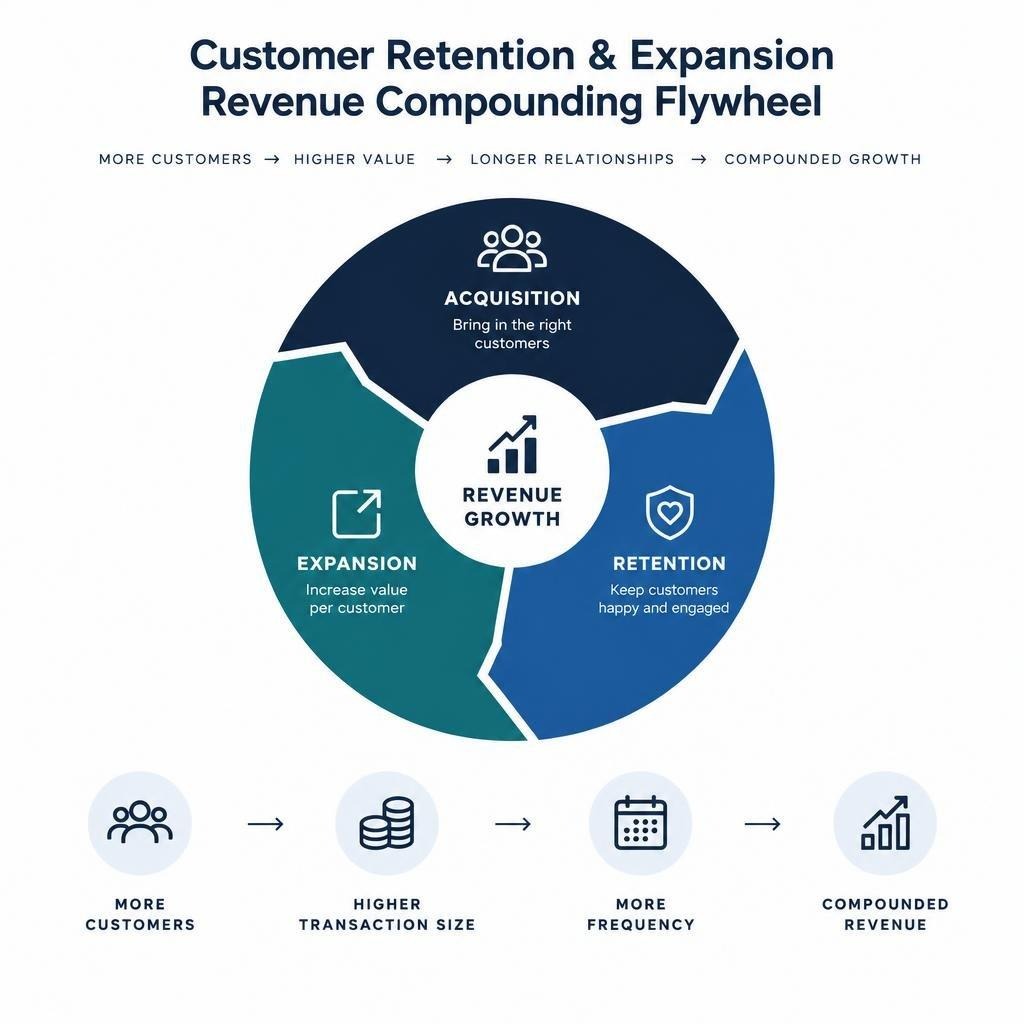
Many executives focus exclusively on lead acquisition, but true scalability lies in the geometric compounding of three fundamental levers: the number of clients, the average transaction size, and the frequency of purchase. Because these levers are multiplicative rather than additive, small improvements in each lead to exponential gains.
If you improve your client acquisition, average transaction size, and purchase frequency by just 26% each, your total revenue doubles. This is a powerful realization: you do not need to work ten times harder to see ten times the growth. By focusing on monetization and retention—areas often cheaper to optimize than raw acquisition—you create a compounding effect that transforms your bottom line.
Starting-Point Archetypes: Matching Strategic Levers to Market Position
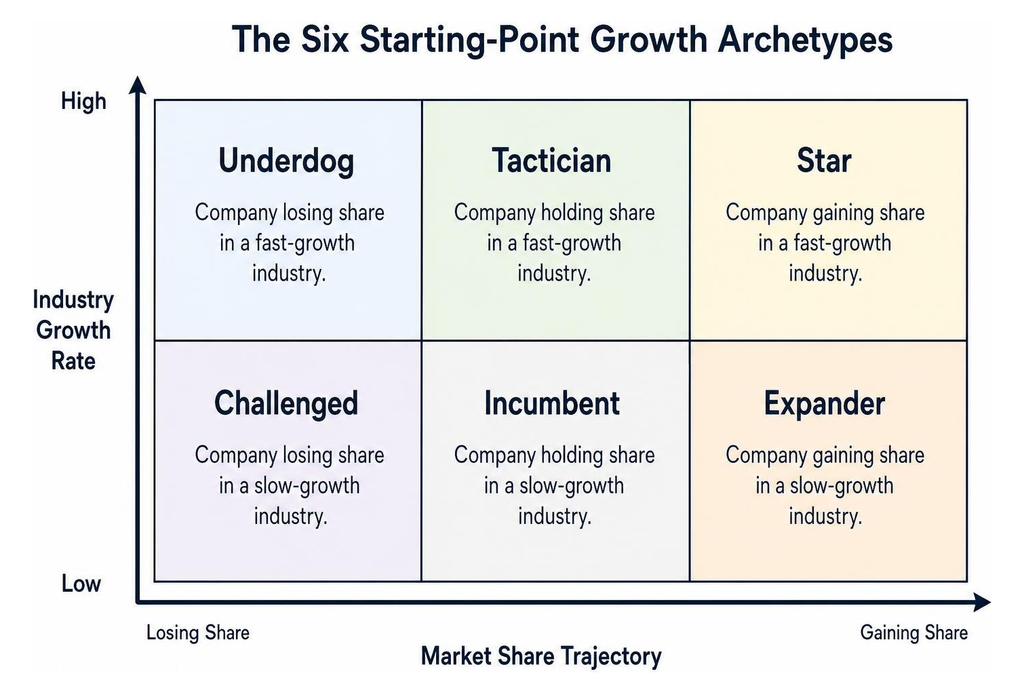
Your growth path is not universal; it is dictated by your starting point. By mapping your company on a matrix of industry growth rates versus your own market share trajectory, you can identify which of the six “starting-point archetypes” you occupy. This diagnostic is essential because the strategies that work for a “Star” (a company gaining share in a fast-growth industry) will often fail for a “Challenged” company (one losing share in a slow-growth industry).
Capital Allocation Across Stars, Underdogs, and Incumbents
For “Stars,” the priority is scaling the core and investing heavily in sales and marketing to capture as much of the fast-growing market as possible. Conversely, “Underdogs” and “Incumbents” that are losing share in fast-growth markets often need to fix execution gaps or pursue strategic M&A to acquire missing capabilities. These firms typically allocate a significant percentage of their market cap toward acquisitions to close the gap between their current position and the market leaders.
Strategic Plays for Challenged, Tactician, and Expander Archetypes
Companies in slow-growth industries face a different set of challenges. “Challenged” firms, for instance, often need to pivot their R&D spend toward innovation and new-frontier adjacencies to break out of their decline. “Tacticians” gain share by being highly selective with M&A, often looking outside their core to find new value. For organizations in the medical sector, this might involve strategies for sustainable medical practice growth that prioritize patient retention and service expansion over raw volume. Regardless of the archetype, the goal is to align resource allocation with the specific constraints and opportunities of your market position.
Proven Revenue Growth Strategies Across the Customer Lifecycle
Growth is most sustainable when it is built into the customer lifecycle. Rather than viewing sales as a transactional event, modern leaders treat it as a continuous loop of acquisition, retention, and expansion.
Value-Based Pricing and Packaging Optimization
Pricing is frequently the most under-managed lever in the growth toolkit. By moving from flat pricing to value-based tiers or usage-based models, companies can better capture the willingness-to-pay across different customer segments. Implementing discount governance and dynamic pricing structures allows firms to protect their margins while ensuring that the product remains accessible to target buyers.
Customer Retention and Account Expansion Systems
Acquiring a new client can cost five to seven times more than retaining an existing one. Therefore, Net Revenue Retention (NRR) should be a primary KPI for any growth-focused organization. By implementing cross-sell playbooks and habit-forming features, companies can turn their existing base into a reliable engine for expansion revenue.
Implementing Intent-Driven Revenue Growth Strategies
To ensure these efforts are not wasted, businesses must align their go-to-market activities with actual buyer intent. By leveraging a modern revenue intelligence platform, teams can surface signals of buying intent long before a prospect reaches out. This allows for hyper-personalized marketing and sales outreach that addresses the specific pain points of an account, significantly increasing pipeline velocity and conversion rates.
Operational Architecture: Bridging Execution Gaps for Predictable Scaling
Even the best strategy will fail if the internal operations cannot support it. We often see companies with brilliant growth plans stall because they suffer from “the operational gap”—a state where lead-time reliability, quality defects, or capacity constraints prevent them from delivering on their promises.
Eliminating Execution Friction with Lean Growth Management
To scale predictably, businesses must adopt a discipline of lean growth management. This involves value-stream mapping to identify where friction occurs in the customer journey. By applying methodologies like Hoshin Kanri, organizations can translate high-level revenue goals into daily, measurable objectives for every team member. When you remove execution bottlenecks, you effectively increase your capacity to grow without necessarily increasing your headcount.
Cross-Functional Alignment and Revenue Architecture
Modern revenue growth requires a “Revenue Architect” mindset. This means breaking down the silos between sales, marketing, and customer success. For many, this requires executive guidance through fractional CMO leadership to ensure that the entire GTM engine is pulling in the same direction. When the organization is aligned, forecasting shifts from a guessing game to causal analysis, where leaders can see exactly which inputs are driving which outputs.
Performance Tracking: Governance and Key Growth Indicators
What gets measured gets managed. However, the trap many companies fall into is focusing solely on “backward-looking” indicators like total revenue or past-month sales. To drive future growth, you must track leading indicators that provide a view of what is to come.
Essential KPIs for Monitoring Modern Revenue Growth Strategies
Beyond standard revenue growth, high-performing firms track:
- Net Revenue Retention (NRR): To measure the health of the existing customer base.
- Pipeline Velocity: To understand the speed and efficiency of the sales cycle.
- Customer Acquisition Cost (CAC) vs. Lifetime Value (LTV): To ensure long-term profitability.
- The Rule of 40: A common benchmark for SaaS companies that balances growth rate and profit margin.
Shifting from Confidence Intervals to Causal Forecasting
Forecasting should not be about predicting a number with a margin of error; it should be about understanding the causality behind the numbers. By building feedback loops that connect product usage data, marketing signals, and sales activity, you can create a model that explains why revenue is growing or stalling. This allows for proactive scenario planning, where you can adjust your strategy in real-time based on the signals your revenue architecture is providing.
Frequently Asked Questions About Revenue Growth
How do internal and external factors interact to influence top-line revenue growth?
External factors, such as market demand and economic shifts, set the ceiling for potential growth. Internal factors, such as your pricing strategy and operational efficiency, determine how much of that potential you actually capture. The interaction occurs when your internal processes are agile enough to respond to external signals—for example, adjusting pricing in response to a competitor’s move or shifting marketing spend during an economic downturn.
What distinguishes organic revenue expansion from inorganic growth strategies?
Organic growth is driven by internal efforts, such as launching new products, entering new geographies, or increasing the penetration of your existing customer base. Inorganic growth, such as mergers and acquisitions, provides a faster way to scale but carries higher integration risks. A balanced strategy often uses organic growth to build a strong core while using inorganic moves to acquire missing capabilities or enter new frontiers.
Why do companies frequently experience growth plateaus despite increasing sales spend?
Plateaus usually indicate an operational bottleneck rather than a lack of market opportunity. If you are pouring more money into the top of the funnel but your churn is high, or your sales cycle is too long due to internal friction, you are essentially pouring water into a leaky bucket. Growth plateaus are a signal to stop increasing spend and start optimizing the architecture of the customer journey.
Conclusion
Sustainable revenue growth is rarely the result of a single, brilliant campaign. It is the cumulative effect of disciplined execution, strategic alignment, and the continuous compounding of your core growth levers. By diagnosing your starting point, bridging your operational gaps, and leveraging data-driven tools to understand buyer intent, you can move away from the volatility of “heroic” sales efforts toward a system of predictable, compounding revenue.
The modern business environment is complex, but the path to growth is clear: align your strategy with your market position, optimize your customer lifecycle, and build an operational architecture that supports long-term scaling. When you treat revenue growth as a discipline rather than a goal, you create a foundation that not only survives market shifts but thrives within them.