Introduction
In the evolving world of education technology, few companies have reshaped an entire niche as decisively as Brightwheel. What began in 2014 as a modest attempt to digitize preschool communication has grown into a multi-hundred-million-dollar enterprise serving tens of thousands of early education providers across the United States.
Brightwheel Net Worth
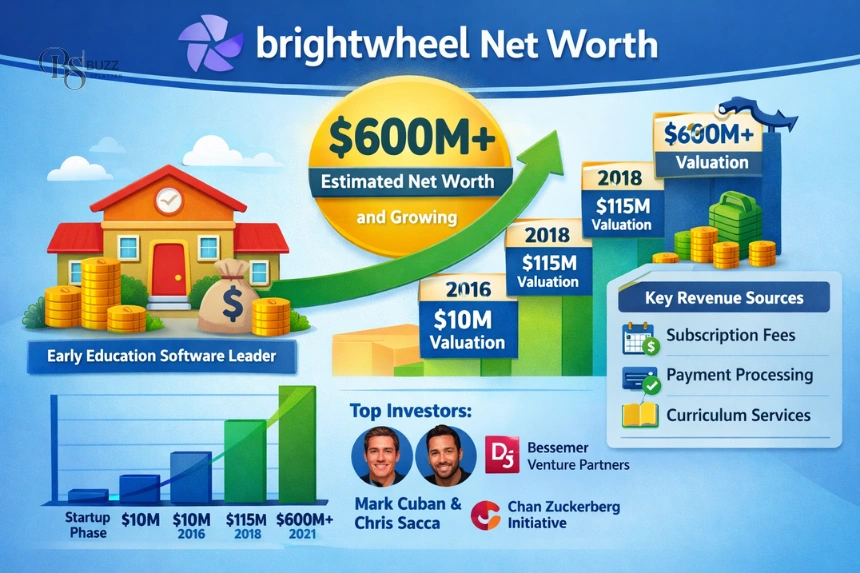
Brightwheel’s net worth reflects its valuation in the venture capital market rather than public stock metrics. Since its early days, the company has experienced rapid growth, with valuation milestones marking its rise in the edtech sector.
After its 2016 Shark Tank appearance, Brightwheel was valued at roughly $10 million. By 2018, following Series B funding, its valuation climbed to around $115 million. The company’s 2021 Series C round catapulted its worth past $600 million, and recent industry estimates suggest it could be approaching the $700 million mark.
While precise figures remain undisclosed, Brightwheel’s net worth today firmly positions it among the most valuable private players in early‑childhood education technology.
Brightwheel: Key Metrics and Milestones
| Fact | Details |
| Founded | 2014, San Francisco, CA |
| Founder / CEO | Dave Vasen |
| Employees | ~500 (2024) |
| Industry | Early-education technology, SaaS |
| Core Features | Attendance tracking, tuition billing, parent-teacher messaging, progress reporting, admin management |
| Business Model | Freemium SaaS: $2.50 per child/month, premium packages ($40–$200+) |
| Revenue | $21.5M (2023); $37.5M (2024) |
| Total Funding | ~$88.8M across seed to Series C |
| Major Investors | RRE Ventures, Eniac Ventures, GGV Capital, Chan Zuckerberg Initiative, Bessemer, Addition Ventures, Mark Cuban, Chris Sacca |
| Valuation / Net Worth | 2016: ~$10M; 2018: ~$115M; 2021: $600M+; 2024-2025: $600-735M |
| Acquisitions / Partnerships | MyChild app (2016), Experience Early Learning curriculum (2023) |
| Market Reach | 25,000+ schools and centers by 2018 |
| Positioning | “Operating system” for early childhood education |
The Foundation: A Digital Operating System for Early Education
Brightwheel was founded in San Francisco by CEO Dave Vasen with a clear mission: to transform early education through technology. The platform provides a unified mobile SaaS system for preschools, daycares, and after-school programs, replacing paper-based workflows with a streamlined digital infrastructure.
Brightwheel’s platform brings together essential childcare operations in one streamlined system, handling attendance, tuition billing and payments, parent-teacher communication, progress reporting, and day-to-day administrative management, replacing traditional paper processes with a unified digital solution.
Within four years of launch, Brightwheel was serving tens of thousands of schools nationwide. By 2024, the company employed roughly 500 people, positioning itself as a leading provider in what investors estimate to be a $100 billion early childhood education market.
Brightwheel’s Business Model: Scalable, Predictable Revenue
A major driver behind Brightwheel net worth is its recurring revenue structure.
The company operates on a freemium SaaS model:
1. Subscription Revenue
Brightwheel charges an average of about $2.50 per child per month, while larger schools and institutions typically pay fixed monthly fees ranging from $40 to over $200, depending on the premium features and services they choose.
2. Payment Processing Fees
Brightwheel facilitates tuition collection, often generating transaction or service fees.
3. Value-Added Services
Additional offerings, such as integrated curriculum tools and reporting packages, create upsell opportunities. The integration of Experience Early Learning curriculum expanded its educational content capabilities.
This predictable subscription-based revenue model has allowed Brightwheel to demonstrate strong year-over-year growth:
- 2023 revenue: $21.5 million
- 2024 revenue: $37.5 million (74% year-over-year growth)
Recurring revenue, high retention rates, and market stickiness have strengthened investor confidence, fueling higher valuations.
Funding Journey: From Seed Stage to $600M+ Valuation
Brightwheel’s financial ascent can be traced through its funding rounds.
2015 – Seed Round ($2.2M)
Led by RRE Ventures and Eniac Ventures, this early capital allowed product expansion and team building.
2016 – Shark Tank Investment ($600K)
A defining public moment came when Dave Vasen appeared on Shark Tank. He secured a $600,000 investment from Mark Cuban and Chris Sacca.
At that time, Brightwheel’s implied valuation hovered around $9-10 million post-money. The appearance significantly boosted brand visibility.
2017 – Series A ($10M)
Led by GGV Capital, with participation from Chan Zuckerberg Initiative and ICONIQ.
2018 – Series B ($21M)
Led by Bessemer Venture Partners. By this stage, Brightwheel’s valuation was approximately $115 million.
2021 – Series C ($55M)
Led by Addition Ventures, with backing from Emerson Collective, Next Play Ventures, and several prominent investors.
Following this round, Brightwheel’s post-money valuation reportedly exceeded $600 million. According to financial data sources, the company’s valuation jumped dramatically between 2018 and 2021.
Brightwheel has raised approximately $88.8 million in venture funding.
Financial Growth Timeline
A closer look at Brightwheel’s trajectory reveals sustained scaling:
| Year | Milestone / Event | Funding / Valuation / Revenue |
| 2014 | Company founded | – |
| 2015 | Product launch | $2.2M seed funding |
| 2016 | Shark Tank deal | Valuation ~$10M |
| 2017 | Series A funding | $10M |
| 2018 | Series B funding | $21M; valuation ~$115M |
| 2021 | Series C funding | $55M; valuation $600M+ |
| 2023 | – | Revenue $21.5M |
| 2024 | – | Revenue $37.5M; ~500 employees |
The acceleration between 2018 and 2021 was particularly striking, driven by digital adoption trends and growing demand for remote administrative tools.
Market Position: The “Operating System” of Early Education
Investors frequently describe Brightwheel as the “operating system” for early childhood education. That characterization reflects its deep integration into daily operations of childcare centers.
By 2018, the platform reportedly served over 25,000 schools and centers, a scale that reinforced network effects and market dominance.
Early backers like Eniac Ventures referred to Brightwheel as the de facto software standard for early education providers. Addition Ventures’ leadership publicly praised its industry positioning when leading the Series C round.
Strategic Expansion: Acquisitions and Partnerships
Brightwheel has not relied solely on organic growth.
- 2016: Acquisition of MyChild, a parent-communication app
- 2023: Integration with Experience Early Learning curriculum
These strategic moves strengthened its product ecosystem, increasing customer stickiness and revenue per account.
By embedding curriculum tools directly into its administrative platform, Brightwheel expanded beyond operations into instructional support, deepening its role in early education.
Conclusion
Brightwheel net worth is not the product of hype alone. It reflects a decade of methodical scaling, strategic fundraising, and deep market penetration in early childhood education.
From a $10 million valuation after a Shark Tank appearance to a company valued at more than $600 million, Brightwheel exemplifies the power of vertical SaaS done right. It identified a fragmented, paper-heavy industry and built the digital backbone that now supports thousands of schools nationwide.