The firearm optics market is full of noise. Big claims, inflated prices, products that look the part on paper and fall apart in the field. Buying the wrong optic is an easy mistake to make, especially if you are newer to the space or building out a rifle on a real budget.
This guide walks you through what actually matters when you are shopping for firearm optics, where the common mistakes happen, and how to make a smart decision the first time without paying for something you do not need.
Understand What You Are Actually Buying
Firearm optics break into a few clear categories. Knowing which one you need before you start shopping saves you from getting talked into something that does not fit the job.
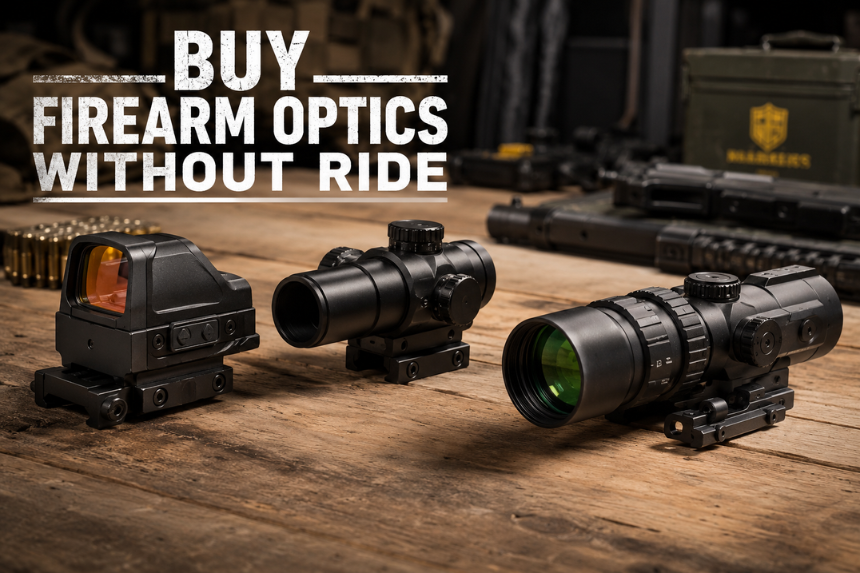
Red dots and reflex sights are 1x, no magnification, built for speed at close range. Best for rifles and handguns used inside 100 yards where fast target acquisition matters.
Fixed magnification optics run a single set magnification, commonly 4x for rifle use. Simple, reliable, no adjustment needed in the field. Good for a dedicated mid-range rifle where the distance does not change much.
Low power variable optics (LPVOs) run a magnification range, typically 1-6x or 1-8x. The bottom of the dial gives you red-dot style speed at close range. The top gives you magnified precision at distance. Best for a rifle that handles multiple roles.
Higher magnification scopes in the 3-9x or higher range are built for precision rifle work, bolt guns, and longer range shooting past what most AR-15 setups are optimized for.
Match the optic to the rifle and the rifle to the job. That sequence matters.
The Mistakes That Cost People Money
A few patterns come up over and over when shooters buy the wrong optic.
Buying for specs instead of use case. A 1-8x LPVO sounds impressive until you realize you shoot almost exclusively inside 50 yards and the extra magnification and weight are working against you. More is not always better. Match the optic to what you actually do with the rifle.
Skipping the mount question. A lot of optics are sold without a mount included. The optic price looks attractive until you realize you need rings or a cantilever mount on top of it, which can add $40 to $100 or more depending on what your rail needs. Always confirm whether a mount is included and what style of mount your optic and rail require before you buy.
Chasing brands without checking what you get. Premium optics brands carry premium prices for good reasons in some cases and for brand name alone in others. A $400 red dot from a recognized name is not automatically four times better than a $100 red dot with verified zero retention and a real warranty. Check the verified buyer reviews before you assume the price gap reflects a performance gap.
Ignoring the warranty. A lifetime warranty that no one can actually claim is not a warranty. Look for documented warranty replacements from real buyers, not just the language on the product page. A company that honors its warranty years after sale is worth knowing about.
What to Check Before You Buy
A short checklist worth running through on any optic before you commit.
Zero retention on your caliber. Does it hold zero under your recoil? Reviews from buyers running the same caliber are the most useful signal here.
Mount included or not. Know what you are getting and what the fully mounted cost actually is.
Battery life and reticle type. If the reticle is illuminated and battery dependent, how long does the battery last? If it is etched glass, it works without battery power, which matters for some applications.
Warranty terms and actual claim history. Not just what the warranty says, but whether it pays out in practice.
Fit for your rail. Mil-spec Picatinny rails are standard, but not all rails are identical. If you are running a non-standard setup, confirm fitment before ordering.
Where to Buy Firearm Optics Online
Ozark Armament is a solid option for AR-15 optics at honest prices. They carry red dots, fixed magnification optics, and LPVOs across a range of price points from under $50 to around $230, all backed by a no nonsense lifetime warranty and free shipping on every order.
Their Rhino Red and Green Dot Reflex Sight runs $49.99 and has been compared favorably to optics costing four to five times as much by verified buyers who own both. Their Rhino 4x fixed magnification optic sits at $79.99 and runs an etched reticle that works without battery power. Their Razorback 1-6×24 LPVO at $229.99 ships with a cantilever mount included, which is uncommon at that price point and meaningful when you factor in total cost.
Over 2,200 verified buyer reviews across their optic lineup average out to 4.6 stars. That kind of review volume from real buyers is a more reliable signal than any spec sheet.
If you are ready to buy firearm optics without overpaying for a brand name or getting sold something that does not fit your build, browse the full lineup at ozarkarmament.com.
A Note on Budget vs Performance
There is a real performance gap between a $30 optic from an unknown source and a quality optic with verified zero retention and a warranty that pays out. That gap is worth paying to close.
There is not always a meaningful performance gap between a $100 optic with those qualities and a $400 optic with the same ones. The difference there is often brand equity, not field performance. Know what you are paying for.
Buy the best optic that honestly fits your use case and your budget. Do not buy a premium brand name to fill a role where a well built, well reviewed optic at a fraction of the price does the same job.
The Bottom Line
Buying firearm optics well comes down to knowing your use case, checking the right specs, confirming total cost with mount included, and buying from a company with a warranty that actually means something.
Ozark Armament covers all of those boxes at prices that leave money in your pocket for ammunition. See the full lineup at ozarkarmament.com.