Most people have moved at some point. Pack the boxes, rent a truck, recruit a friend or two, drive across town, and unpack over the next weekend. It’s exhausting, but it’s a familiar kind of work.
A commercial relocation is a different category entirely. Imagine the same exercise scaled up to three hundred employees, eighty workstations, two server racks, a lab full of specialized equipment, six conference rooms, and a deadline that’s already been moved twice. The business needs to keep operating throughout. By the time the work is done, the new office should look like the old one, only with different walls.
Most people never think about how commercial moves are coordinated at scale, but every desk, server, file cabinet, and piece of specialized equipment has to land in the right place at the right time, often inside a window narrow enough that the company can’t afford to lose a day. Behind that single move is a coordination operation that begins long before anyone touches a box.
It’s Not a Move. It’s a logistics operation.
Residential moving is, broadly, a matter of muscle and trucks. Commercial moving isn’t.
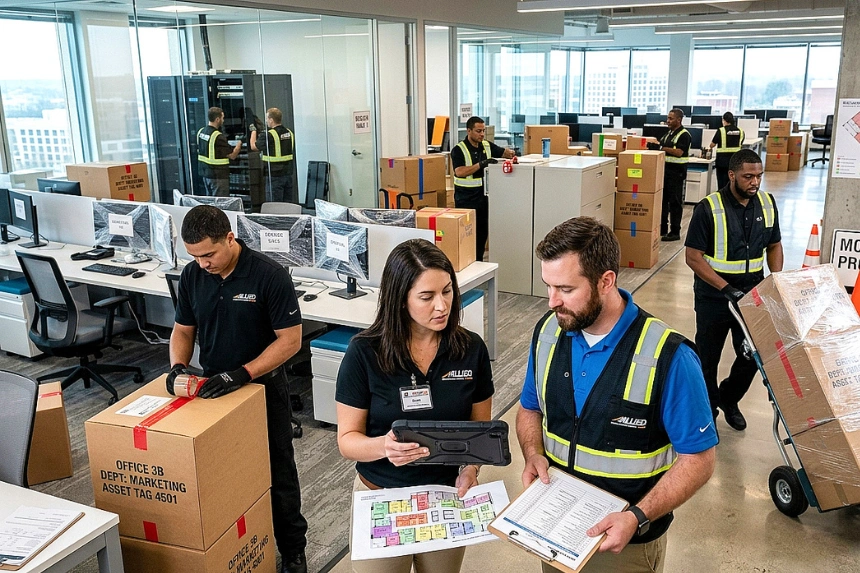
A commercial relocation, particularly for a mid-sized or larger operation, often begins weeks or months before move day. There’s a project manager assigned. A floor plan gets drafted for the new space. An inventory is taken of every piece of furniture, every piece of equipment, every cable run, and every printer that’s old enough that nobody quite remembers if it still works. Departments get tagged in waves. IT plans the cutover. HR schedules employee notifications and parking changes. Building management gets looped in for elevator reservations and dock access.
Once the actual move day arrives, the trucks are almost the easiest part of the job.
The Inventory of an Entire Business
A commercial relocation is, fundamentally, an inventory problem.
You can’t simply throw an office on a truck. Every chair has an asset tag. Every monitor needs to land on a specific desk so a specific person can keep working on Monday. The legal department’s filing cabinets can’t get mixed up with the accounting department’s. Lab equipment often needs to be calibrated again after transit, which can require a vendor visit, which has to be scheduled. Documents marked confidential need a chain-of-custody trail that holds up to audit.
Commercial movers spend significant time before move day labeling, tagging, and mapping. That’s why a commercial moving crew shows up with a clipboard and a project lead, not just hand trucks. The clipboard is doing more of the work than the muscle is.
Specialized Equipment, Specialized Handling
A meaningful share of what gets moved during a commercial relocation isn’t standard office furniture. It’s specialized equipment that needs careful handling and, in some cases, manufacturer involvement.
Server racks need to be powered down in a specific sequence and packed in a way that keeps drives from getting jolted. Medical and dental practices have imaging equipment that often requires the manufacturer’s technician on-site for de-installation and re-installation. Construction firms have heavy machinery that needs flatbeds and permits. Government contractors and military-adjacent operations need movers who can pass site security and handle the additional documentation those projects require.
Federal regulators track interstate carriers across the board. The Federal Motor Carrier Safety Administration registers movers, requires insurance, and publishes tools for verifying that a carrier is legitimate. Commercial clients tend to verify this carefully, because hiring an unregistered carrier for an interstate business move is the kind of mistake that can create real liability.
The Coordination Problem
A commercial move usually has more stakeholders than people realize. The mover is just one of them.
Inside the company, there’s a project lead; IT, HR, facilities, and likely legal weighing in on records handling. Outside the company, there’s building management at both the old and new sites (each with its own rules about insurance certificates, freight elevators, and after-hours access), vendors for IT cabling and furniture installation, possibly a real estate firm tracking lease dates, and the moving company coordinating it all into a sequence that actually works.
It’s a project management exercise that happens to involve trucks. Not the other way around.
Long-Distance and Multi-Site Moves
When a business move crosses state lines, the operation gets more layered.
Now there are interstate carrier rules to follow, multi-state permitting, and timing windows that have to account for hours-of-service regulations on commercial drivers. Multi-site moves, like a company consolidating two regional offices into one, require coordinating multiple pickup origins, multiple inventory streams, and a single delivery destination that has to receive everything in the right order so unpacking doesn’t turn into chaos.
Regional movers with national network affiliations matter here. A local company that’s part of a larger van line network can move a business out of Virginia and into Texas without handing the shipment off to a stranger halfway through. The driver, the truck, and the paperwork all stay inside one accountable system. For the roughly 6.6 million Americans working in transportation and warehousing, this kind of cross-state coordination is part of the daily work.
Business Continuity Is the Unspoken Constraint
The defining feature of commercial moving, the one that distinguishes it from residential work entirely, is that the business has to keep operating throughout.
A hospital can’t be shut down for a weekend. A manufacturer can’t tell its customers that orders will be delayed three weeks because the warehouse is being moved. Employees can’t simply stop working until the new office is set up. Commercial moves are usually planned in waves. Departments get moved on staggered schedules. Critical systems get migrated overnight. Some businesses run two parallel operations during the transition period, one in each location, until the cutover is complete.
The mover’s job is to fit into that pattern, not the other way around. That’s why timing precision matters. Showing up an hour late can blow a building elevator reservation. Showing up a day late can cost the client real money in lost work.
Who Actually Does This Work
Companies that handle commercial relocations regularly tend to specialize. Most are not household goods movers who happen to also do offices.
Dunmar Moving Systems is one example. Based in Virginia and operating since 1970 as an Allied Van Lines agent, the company runs commercial moves out of five offices across the Commonwealth, with locations including Richmond, Norfolk, Roanoke, and Blacksburg. Per their own description, they handle commercial relocations of varying sizes, corporate relocations, and office moves, with experience handling moves at military installations like Fort Lee and Langley Air Force Base. National coverage looks national in the marketing. On the ground, it’s run by regional operators stitched into broader van line networks.
What Goes Wrong
Commercial moves break in their own particular ways.
Building management at the destination forgets the freight elevator booking. The new office’s data cabling isn’t finished, so IT can’t bring the network online, so employees show up to a new building with desks but no working internet. A specialty piece of equipment arrives, but the manufacturer’s installer is unavailable, so it sits in a corner for three days. The wrong department’s boxes go to the wrong floor, and someone spends a Saturday relabeling.
Most of these issues are recoverable. None of them are cheap. The reason commercial movers cost more than a residential operation isn’t just the labor. It’s the planning, the coordination, the contingency budget, and the willingness to take ownership when something fails.
Why Most People Don’t See This Layer
Commercial moving doesn’t get the same attention as consumer logistics. There are no Super Bowl ads about office relocation. No influencer content explaining how to schedule an IT cutover. The category is invisible by design, because the customers are companies rather than consumers, and the work happens on weekends when nobody is there.
Invisible doesn’t mean small, though. American businesses move every day, somewhere. Mergers, lease expirations, expansions, downsizing, post-pandemic real estate adjustments. Each of those events sets off a logistics operation that, done right, looks like nothing happened. The employees show up Monday at the new building, the printers work, the servers are online, and the business continues.
That’s the test. Not whether the move went well, but whether it looked like nothing happened.