
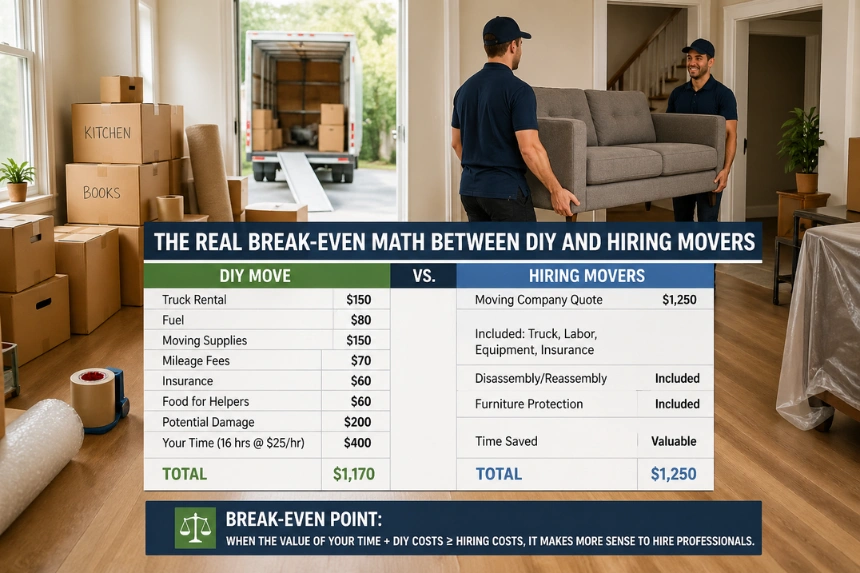
Most “DIY vs. movers” articles end with a vague verdict. It depends. Get quotes. Your situation is unique.
True, but useless.
What people want is a number. At what point does hiring a crew stop being more expensive and start being cheaper than doing it yourself? That break-even point exists. It just gets buried under hourly rates, mileage charts, and the assumption that DIY is automatically the cheap option.
Below is what the math looks like, with real cost data, three example scenarios, a checklist, and the part movers will tell you when asked: when DIY genuinely makes more sense than hiring.
The Numbers Both Sides Start With
NerdWallet, citing data from Move.org, puts average local truck rental at around $150 before mileage, fuel, and insurance. Their data on professional help, sourced from Moving.com, runs $38 to $75 per mover per hour for local jobs.
Bankrate’s number for hired local move with two pros and a truck is more specific: an average of $1,711, with a typical range of $883 to $2,556 from HomeAdvisor data. For a cross-country move, that average jumps to $4,579, with a range of $2,404 to $6,862.
Those are the headline figures. The break-even math comes from what gets added to each side.
On the DIY side, the line items most people leave off the napkin estimate include packing supplies, per-mile rental fees, optional truck insurance, fuel for low-mpg box trucks, and damage replacement when something does not survive the trip. Lost wages or unused vacation days belong here too if the move eats a workday.
On the higher side, what is usually included in the quoted price covers the trained crew, furniture pads, dollies and straps, basic released-value damage coverage, loading and unloading, and disassembly and reassembly of standard furniture. The exact list varies by company and should be confirmed in writing.
When both lists are written out honestly, the gap shrinks fast.
The break-even calculation reduces to one line:
(Hours × Your Time Value) + DIY Cash Costs vs. Hired Quote
If the left side is greater than the right, hiring wins on total cost. If it is smaller, DIY wins. The variables shift by move, but the structure does not.
Three Scenarios That Show Where the Line Falls
The break-even point is not the same for every move. The three scenarios below show how it shifts. Numbers are illustrative, drawn from the typical local-market ranges in the sources above.
Scenario 1: Studio apartment, 5 miles away, ground floor to ground floor. DIY: roughly $150 for truck rental, $30 for fuel, $40 in supplies, plus a thank-you for one helper. The cash total is around $250. Time, about half a day. Hire: two movers, 3-hour minimum, in the $250 to $400 range. Verdict: roughly even on cash. DIY wins when a free afternoon and one strong friend are available. Hiring wins when neither is.
Scenario 2: two-bedroom apartment, 30 miles, one flight of stairs at the origin. DIY: $200 truck rental, $80 fuel, $150 supplies, mileage fees, food for helpers, and plus about ten hours of weekend time. Cash cost lands in the high $500s. Hire: three movers, 5 to 7 hours, in the $700 to $1,200 range. Verdict: this is the gray zone. With an hourly value above roughly $30 and no spare weekend, hiring tends to win on net cost. With time and free help, DIY pulls ahead by a couple hundred dollars.
Scenario 3: Three-bedroom house, 100 miles, full furniture load. DIY: $400 to $700 for the truck, $250 for fuel, $250 for supplies, mileage, plus 16 to 24 hours of labor, and a high probability of two trips. Cash costs around $1,200, plus a full weekend gone. Hire: typically $1,800 to $3,500 depending on weight and access. Verdict: hiring wins on cost-adjusted-for-time. DIY at this size also carries the highest damage risk, which can widen the gap further.
What Crews See That Shifts the Math
Talk to people who do this for a living, and a pattern emerges. The DIY budget sketched at home rarely matches what happens on the day.
What follows is not theoretical. These five issues show up on dispatch sheets and call notes across every season:
Truck size errors are the single biggest budget breaker. The miscalculation usually isn’t weight. It’s cubic feet. People pack by what fits in their hands and forget the truck has to hold a load three-dimensionally. When the second trip happens, it costs another tank of gas, another rental hour or two, and a chunk of daylight nobody planned for.
Then there is the lifting side, where weight gets underestimated separately. A dresser with drawers full of clothes is heavier than it looks. Two people carrying that down a flight of stairs is how injuries happen, and emergency room visits do not show up in the DIY budget either.
Padding and protection are the line items DIY movers skip most often. A professional crew shows up with a stack of furniture pads. Most DIY moves run on two old blankets and hope. The damage rate reflects the difference.
The point where quotes spike isn’t distance. It’s a staircase. A two-floor walkup five miles away can be priced higher than a flat home twenty miles out. Stairs roughly double the labor time on furniture, which is why hired pricing weighs accessibility over miles. DIY budgets rarely account for it.
And damage rarely shows up the same day. A scuffed table, a chipped wall, a torn box spring. These get noticed during unpacking, when the budget is already closed.
The Quick Decision Checklist
Run through these. Each “yes” pulls the math toward hiring.
- The move involves more than one flight of stairs at either end
- The new home is more than 50 miles away
- The household contains anything heavier than a queen mattress on its own
- The schedule is locked, with no buffer day on either end
- Your hourly value, after taxes, is above $35
- Two or more friends who said yes have already gone quiet
- The home has appliances that need disconnecting and reconnecting
- A piano, gun safe, or any item over 200 pounds is involved
With three or more yes answers, hiring usually wins on total cost. One or two: the gap is small enough to choose based on preference. Zero, DIY is genuinely the cheaper option, and any honest moving crew will say so.
One of the fastest ways the math flips is when packing time gets compressed into a single service window. That’s where getting help with packing and unpacking with Best of Utah (especially if you’re relocating to or within Utah) starts to shift the total cost closer to, or even below, a full DIY move.
When DIY Genuinely Wins (And Movers Will Say So)
The angle most articles miss: hiring is not the right call for every move. There are real situations where DIY wins clean, and reputable crews are not in the business of arguing otherwise.
Small moves with light loads. A studio with a futon and three boxes handled by a pickup truck and one strong friend in two hours, full stop. Short-distance moves where everything fits across a couple of car trips. Moves where the timeline is generous and the labor is free. Moves where the household value is low enough that damage risk does not change the math.
In those cases, hiring is overpaying for a service the move does not require. The companies worth working with will say so on a quote call. The ones that try to upsell every small move are the ones to avoid.
Getting the Number That Settles It
The fastest way to find the real break-even point for a specific move is to put two figures side by side: a full DIY total (truck rental, supplies, fuel, mileage, and the value of the time it will consume) and one written quote from a hired crew.
Most quotes take under ten minutes to request. Having one number on paper changes the decision instantly. The math either confirms the DIY plan or quietly reveals that hiring is a few hundred dollars away from being the smarter call.
The break-even point exists. It is not the same for every move. Once both numbers are on the table, it stops being a debate.